Coax
Coaxial
6"
CX6F140F
Code: CX6F140FX8X8-361C
Coaxial:LF-6"/Ferrite/Paper/100W/8ohm,HF-1.4"/Ferrite/Polmyer/30W/8ohm
Key Features
- LF and HF combined magnetic circuit
- Compact, but powerful speaker
- Magnetic circuit combining ferrite and neodymium magnets
Quick Specs
Impedance
8 Ω
Program Power
LF: 200 W / HF: 60 W
Sensitivity
95.50 dB
Magnet
Hybride
Voice Coil
LF: 44.5 mm / HF: 35.6 mm
Design Notes
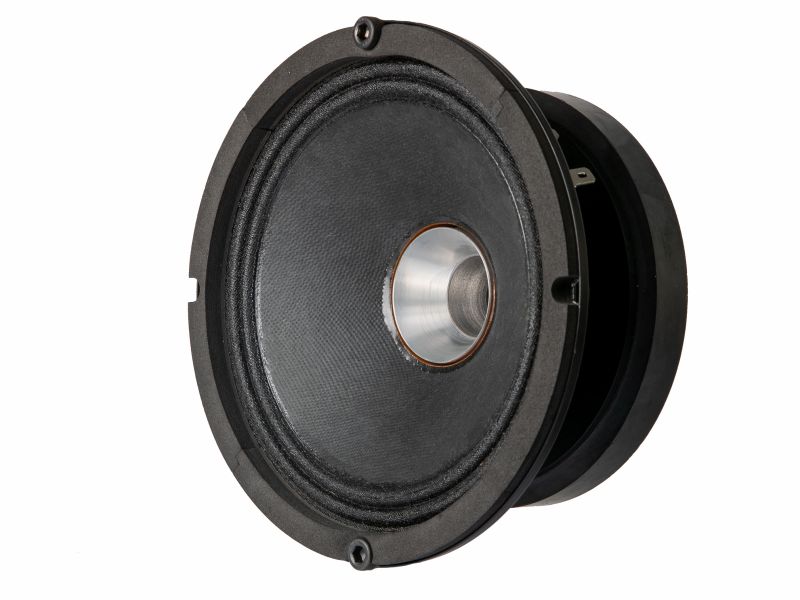
The CX6F-140F is a high efficiency, (93dB 1watt / 1 meter) 6.5-inch coaxial speaker with very linear frequency response characteristics and high power handling capability. The mid-woofer utilizes REDCATT developed paper pulp cone that has proven its performance in many our successful designs. The HF section was designed around our most successful dome assembly as used in 140FCD. The mini waveguide is CNC machined from single piece of aluminum, given the whole assembly incredible precision. The combination of used materials with our state of the art quality production yields in well performing driver even in the most demanding extreme conditions.
Magnetic circuit design
REDCATT engineers have developed ferrite-neodymium based magnetic circuit, capable of delivering the highest level of performance in a small form factor. The combination of ferrite and neodymium delivers an excellent magnetic performance. The magnetic circuit design is optimized to generate the minimum amount of flux modulation, providing exceptional stability. Aluminum demodulation ring is assembled in the HF section.
Magnetic circuit design
REDCATT engineers have developed ferrite-neodymium based magnetic circuit, capable of delivering the highest level of performance in a small form factor. The combination of ferrite and neodymium delivers an excellent magnetic performance. The magnetic circuit design is optimized to generate the minimum amount of flux modulation, providing exceptional stability. Aluminum demodulation ring is assembled in the HF section.
Specifications
General Specs
Nominal Diameter
6"
Rated Impedance
8 Ohm
Magnet
Hybride
Basket Material
Steel
Power Handling
AES Power
LF: 100 W / HF: 30 W
Continuous Power
LF: 200 W / HF: 60 W
Peak Power
LF: 400 W / HF: 120 W
Voice Coil
Diameter
LF: 44.5 mm / HF: 35.6 mm
Winding Wire
CCAR
Former
Glass Fiber/kapton
Winding Height
10/2.5 mm
T/S Parameters
Qes
0.520
Qms
4.73
Qts
0.470
Vas
4.40 liters
Sd
141.00 cm\u00B2
Mms
10.90 grams
Rms
1.75
Cms
0.1600
Bl
9.27 T\u00B7m
Le
0.450 mH
Sensitivity
95.50 dB
Design Details
Surround Material
fabric/PEN
Cone/Dome Material
Paper CF/PEN
Spider
Nomex
T-Plate
6 mm
Xmax (peak)
2 mm
Xmech
8 mm
Overall Diameter
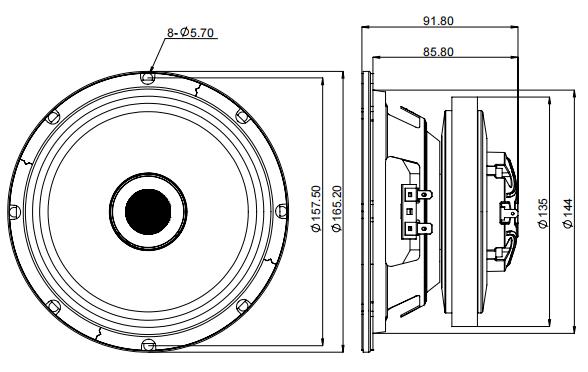
165.20 mm
Bolt Circle Diameter
157.50 mm
Baffle Cutout Dia.
144.00 mm
Mounting Holes
8
Depth (flange to rear)
85.80 mm
Net Weight
2.10 kg
Ordering Codes
Product Code
CX6F140FX8X8-361C
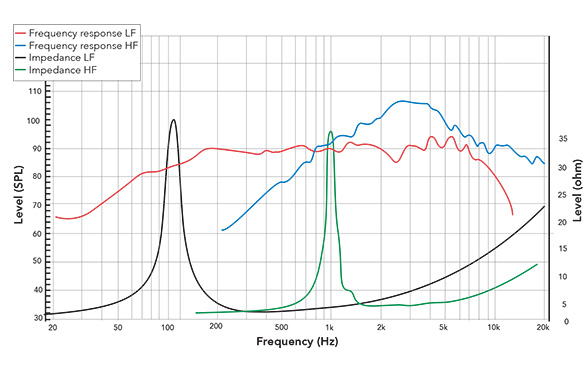
Frequency Response & Impedance
2D Drawing
Enclosure Recommendations
SPEAKER ENCLOSURE CALCULATION — CX6F140FX8X8-361C
DRIVER IDENTIFICATION
Code: CX6F140FX8X8-361C
Name: CX6F140F
Category: Coaxial — LF 6.5" / HF 1.4" (separate product class from full-range family)
Brand: REDCATT
DUAL-VALUE NOTATION:
Parameters listed as A/B follow the user convention: A = LF section, B = HF section.
Single-value parameters apply to the LF section unless noted.
CONSTRUCTION
── LF SECTION (6.5" woofer) ──
Nominal Impedance: 8 Ω (Re = 5.4 Ω DC)
AES Power: 100 W
Continuous Power: 200 W
Peak Power: 400 W
Voice Coil: 44.5 mm diameter, Glass Fiber former
L-Winding: 10 mm
Cone: Custom paper pulp (Paper CF) — REDCATT-developed
Surround: Fabric (woven surround)
Spider: Nomex
T-Plate: 6 mm
── HF SECTION (1.4" dome tweeter, coaxially mounted) ──
Nominal Impedance: 8 Ω (Re = 5.5 Ω DC)
AES Power: 30 W
Continuous Power: 60 W
Peak Power: 120 W
Voice Coil: 35.6 mm (1.4") diameter, CCAR wire, Kapton former
L-Winding: 2.5 mm
Dome: PEN (polyethylene naphthalate) — high-temperature polymer
Surround: PEN
Waveguide: CNC machined from single piece of aluminum — high precision;
provides acoustic loading and pattern control for the HF dome;
enables extended low-frequency HF operation (to ~1.5 kHz)
── SHARED STRUCTURE ──
Magnet: Hybrid ferrite-neodymium (combined single magnetic circuit for
both LF and HF — see note below)
Basket: Steel, dual-gasket front and rear mounting
Overall Dia.: 165.2 mm
Bolt Circle Dia.: 157.5 mm (note: 8 mounting holes — vs. 4 for standard drivers)
Baffle Cutout: 144 mm
Depth: 85.8 mm
Net Weight: 2.1 kg
NOTE ON HYBRID FERRITE-NEODYMIUM COMBINED MAGNETIC CIRCUIT:
The defining engineering feature of the CX6F140FX8X8-361C is its single magnetic
circuit serving both the LF woofer voice coil (44.5 mm) and the HF dome voice coil
(35.6 mm). REDCATT engineers combined ferrite and neodymium materials to achieve the
magnetic flux density required for both voice coil gaps simultaneously in a compact
form factor. The hybrid topology allows each material to contribute where it is most
effective: ferrite for the high-flux-volume LF gap and neodymium for concentrated
high-density flux in the compact HF gap. The design is optimized to minimize flux
modulation — the variation of gap flux with cone position — which directly reduces
even-order harmonic distortion products at high drive levels. An aluminum demodulation
ring (Faraday ring) is assembled in the HF section of the circuit, shorting out the
voice coil inductance at high frequencies; this further reduces the intermodulation
and harmonic distortion produced by Le non-linearity in the HF dome.
NOTE ON PEN DOME AND CCAR VOICE COIL (HF):
PEN (polyethylene naphthalate) has higher glass-transition temperature and stiffness
than standard PET film. This improves thermal and mechanical stability of the HF dome
under sustained high-power drive (30W AES). The CCAR (copper-clad aluminum round)
wire on the HF voice coil reduces moving mass relative to solid copper while maintaining
full electrical conductivity, contributing to the high HF sensitivity.
NOTE ON CNC ALUMINUM WAVEGUIDE:
Single-piece CNC machining provides tight geometric tolerances — waveguide throat and
mouth dimensions are consistent unit-to-unit, directly affecting HF loading, sensitivity,
and polar pattern reproducibility. The waveguide acoustically loads the HF dome, extending
the usable operating range down toward 1.5 kHz and controlling the horizontal/vertical
dispersion pattern of the HF section. This is the same dome assembly technology as
used in the 140FCD standalone HF driver.
NOTE ON GLASS FIBER FORMER (LF):
The LF voice coil uses a glass fiber (fiberglass) former instead of the more common
Kapton. Glass fiber provides higher thermal conductivity and higher maximum operating
temperature than Kapton, supporting the 100W AES / 200W continuous power rating.
The Bl = 9.27 T·m combined with the glass fiber former enables sustained high-power
operation without the former degradation risk that limits aluminum and Kapton formers
at extreme temperatures.
THIELE-SMALL PARAMETERS
── LF SECTION ──
Fs = 121.0 Hz (free-air resonant frequency)
Re = 5.4 Ω (DC voice coil resistance)
Qes = 0.52 (electrical Q)
Qms = 4.73 (mechanical Q)
Qts = 0.47 (total Q — vented / sealed both viable; vented primary)
Vas = 4.4 L (equivalent air volume)
Sd = 141.0 cm² (effective cone area — largest in all REDCATT drivers processed)
Mms = 10.9 g (moving mass)
Rms = 1.75 kg/s (mechanical resistance)
Cms = 0.16 mm/N (compliance)
Bl = 9.27 T·m (force factor)
Le = 0.45 mH (voice coil inductance — LF section)
Xmax = 2.0 mm (one-way linear excursion — LF)
Xmech= 8.0 mm (one-way mechanical limit — LF)
Xprot= 9.2 mm (one-way protection limit — LF)
Consistency check (Qts): Qes×Qms / (Qes+Qms) = 0.52×4.73 / (0.52+4.73)
= 2.460 / 5.25 = 0.469 ≈ 0.47 ✓
── HF SECTION ──
Fs_HF = 1,000 Hz (free-air resonant frequency of HF dome)
Re_HF = 5.5 Ω (DC resistance)
Lm_HF = 101.0 dB (1W/1m sensitivity — with waveguide loading)
Note: Full HF T/S parameters are not provided. Fs = 1,000 Hz establishes the
minimum useful operating frequency of the HF dome; usable crossover range
begins at approximately 1,500 Hz with waveguide loading.
SENSITIVITY AND MAXIMUM SPL
── LF SECTION ──
Datasheet Sensitivity: 95.5 dB (2.83V/1m, per CSV Sensitivity field)
1W/1m reference (Lm): 93.8 dB (per CSV Lm field)
Consistency check: Re = 5.4 Ω → 2.83V delivers 8.009/5.4 = 1.483W
Expected Sensitivity = 93.8 + 10×log10(1.483)
= 93.8 + 1.71 = 95.5 dB
CSV shows 95.5 dB — consistent ✓
LF Max SPL (AES 100W): 93.8 + 10×log10(100) = 93.8 + 20.0 = 113.8 dB at 1 m
── HF SECTION ──
1W/1m reference (Lm_HF): 101.0 dB (per CSV Lm field, with waveguide loading)
Expected HF Sensitivity: 101.0 + 10×log10(8.009/5.5) = 101.0 + 1.63 = 102.6 dB
HF Max SPL (AES 30W): 101.0 + 10×log10(30) = 101.0 + 14.8 = 115.8 dB at 1 m
LEVEL MATCHING NOTE:
The HF 1W/1m sensitivity (101.0 dB) exceeds the LF sensitivity (93.8 dB) by
7.2 dB. In a passive 2-way crossover, an L-pad or series resistor on the HF
section is required to match levels. For the LF sensitivity of 93.8 dB at 1W,
the HF attenuator should reduce HF output by approximately 7 dB. In an active
(bi-amplified) system, the HF amplifier channel gain is reduced accordingly.
The attenuated HF section still retains significant power headroom — at the
matched level, the HF is operating well within its 30W AES rating.
DERIVED PARAMETERS (LF section)
Volume displacement: Vd = Sd × Xmax = 141 cm² × 0.20 cm = 28.2 cm³
Inductance rolloff: f_Le_LF = Re / (2π × Le) = 5.4 / (2π × 0.00045) = 1,911 Hz
Cone radius: r_cone = √(Sd/π) = √(141/π) = 6.70 cm
Cone beaming onset: f_beam_LF = c / (π × r_cone) = 34400 / (π × 6.70) = 1,635 Hz
Zobel (LF): Rz = 5.4 Ω; Cz = Le / Re² = 15.4 μF (series, across LF terminals)
Column array limit: f_array = c / (2 × OD) = 34400 / (2 × 16.52) = 1,041 Hz ≈ 1.04 kHz
LF Max SPL: 113.8 dB at 1 m (100W AES) — highest LF max SPL processed
Vd = 28.2 cm³: the largest volume displacement in all REDCATT drivers processed
NOTE ON f_Le_LF = 1,911 Hz:
The LF inductance rolloff onset at 1,911 Hz falls within the audio band. In a 2-way
coaxial system, this is not a limiting factor — the LF is crossed over to the HF at
approximately 2–3.5 kHz (well above f_Le_LF). However, passive crossover networks
must include a Zobel network (5.4 Ω + 15.4 μF) to compensate the LF impedance rise
at crossover, which would otherwise shift the crossover frequency and flatten the HF
rolloff of the LF section.
NOTE ON f_beam_LF = 1,635 Hz:
The 6.5-inch cone begins directional beaming above 1,635 Hz. In a single-driver
application (no coaxial HF), this would require a tweeter crossover at or below
1.6 kHz. In the coaxial configuration, the HF dome takes over above the crossover
frequency, so the LF beaming is not a limitation — the coaxial design is specifically
chosen to address this. The crossover should be set at or below f_beam_LF (< 1,635 Hz)
for maximum pattern continuity between LF and HF sections.
ENCLOSURE RECOMMENDATIONS (LF section)
Qts = 0.47 → 0.35–0.50 range: both vented and sealed viable, leaning vented.
Vented enclosures are the primary recommendation for PA and column applications
where bass extension below Fs (121 Hz) is required. Sealed enclosures are the
secondary recommendation for compact 2-way monitor applications.
PRIMARY: VENTED (PORTED)
Port: 50 mm diameter (Ap = 19.64 cm²).
End corrections: flanged end 21.3 mm + unflanged end 15.3 mm = 36.5 mm total.
--- VENTED ALIGNMENTS (50 mm port) ---
Alignment V1: Vb = 5 L | Fb = 95 Hz
Effective port length: 130 mm → Physical port length: ~94 mm
Port air velocity: 8.57 m/s peak (within hi-fi 17 m/s and PA 22 m/s limits)
Note: Small, compact enclosure; Fb near Fs provides load stiffening.
Best for satellite systems with sub-woofer handling content below 80–90 Hz.
Alignment V2: Vb = 8 L | Fb = 80 Hz
Effective port length: 115 mm → Physical port length: ~79 mm
Port air velocity: 7.22 m/s peak
Note: Recommended for column speaker and PA cabinet applications.
Alignment V3: Vb = 12 L | Fb = 70 Hz
Effective port length: 100 mm → Physical port length: ~64 mm
Port air velocity: 6.32 m/s peak
Note: Largest box; best bass extension. Suitable for standalone PA enclosures
operating without subwoofer below 60–70 Hz.
Note on excursion below Fb: Vd = 28.2 cm³ is large; cone excursion rises rapidly
below the tuning frequency. A subsonic high-pass filter at Fb − 10 Hz (60–85 Hz,
depending on alignment) is mandatory at high drive levels.
SECONDARY: SEALED
For compact 2-way monitor applications where bass below ~150–200 Hz is handled
by a separate subwoofer or is not required. The high Fs (121 Hz) means sealed
alignments all produce relatively high f-3dB values.
--- SEALED ALIGNMENTS ---
Qtc = 0.707 (Butterworth): Vb = 3.49 L | fc = 182 Hz | f-3dB = 182 Hz
Note: Practical enclosure size; f-3dB at 182 Hz is the flattest sealed response.
Qtc = 0.85: Vb = 1.94 L | fc = 219 Hz | f-3dB = 188 Hz
Qtc = 1.00 (compact): Vb = 1.25 L | fc = 258 Hz | f-3dB = 203 Hz
Qtc = 1.20 (very compact): Vb = 0.80 L | fc = 309 Hz | f-3dB = 227 Hz
Note: Useful in near-field monitors or studio desktop systems where a subwoofer
handles all content below 200–250 Hz. Very compact per-driver bay volume.
CROSSOVER AND SYSTEM DESIGN NOTES
RECOMMENDED CROSSOVER FREQUENCY (1.5–2.5 kHz):
The system crossover point is governed by multiple constraints:
— Minimum (HF lower limit): ~1,500 Hz (approx. 1.5× HF Fs; with waveguide,
dome is usable from ~1.5 kHz)
— f_beam_LF: 1,635 Hz (LF beaming onset; cross below for
best pattern continuity)
— f_Le_LF: 1,911 Hz (LF inductance rolloff onset)
— Maximum (LF practical limit): ~3,500 Hz (LF high-pass rolloff, Sd constraint)
Optimal crossover: 1,500–2,000 Hz — this simultaneously satisfies all constraints:
below f_beam_LF for pattern continuity, at the HF dome's lower useful limit with
waveguide loading, and before the LF Le rolloff significantly impacts response.
A 24 dB/octave Linkwitz-Riley crossover at 2 kHz is a well-established approach
for professional coaxial systems of this type.
COAXIAL GEOMETRY AND PHASE ALIGNMENT:
In a coaxial driver, the LF and HF acoustic centers are not coincident — the HF
dome sits at a rearward offset from the LF cone apex. This offset must be
compensated in the crossover design (all-pass filter or digital delay) to achieve
correct phase alignment at the crossover frequency, particularly important in
active/DSP crossover systems. In passive crossover designs, the crossover slope
shapes and component values are typically selected by measurement to achieve
phase alignment empirically.
COLUMN ARRAY DIRECTIVITY (f_array = 1.04 kHz for 165.2 mm LF OD):
The 6.5-inch LF frame OD of 165.2 mm limits coherent vertical directivity of the
LF array to approximately 1.04 kHz — the lowest f_array of any driver processed.
Above 1.04 kHz, each LF cone becomes an independent source and vertical directivity
is governed by the coaxial HF tweeter array rather than the LF cone array. Since
the recommended crossover is at 1.5–2.0 kHz, the transition from LF array to HF
array directivity occurs within the crossover region — this is a key design
characteristic of professional PA column systems using large coaxial drivers.
The HF tweeter OD (and waveguide exit diameter) determines the f_array of the HF
array, which will be significantly higher given the much smaller waveguide aperture.
HF LEVEL MATCHING:
A 7.2 dB attenuation of the HF section is required to match the LF sensitivity
(93.8 dB 1W/1m). In passive crossover: an L-pad with series resistance ≈ 3.5 Ω
and shunt resistance ≈ 12 Ω (exact values depend on crossover topology). In
active/DSP systems: digital gain trim of −7.2 dB on the HF amplifier channel.
LF IMPEDANCE AND ZOBEL (passive crossover):
The LF impedance rises significantly above f_Le_LF (1,911 Hz) due to Le = 0.45 mH.
A Zobel network (5.4 Ω + 15.4 μF in series, across LF driver terminals) is
essential before any passive crossover to flatten the LF impedance curve. Without
the Zobel, the LF high-pass crossover rolloff will be distorted by the rising
impedance, causing the actual crossover frequency to shift and the LF-to-HF
transition to be non-ideal.
DUAL-GASKET MOUNTING AND COLUMN CABINET DESIGN:
The 8-hole bolt pattern (vs. 4-hole for standard drivers) provides more uniform
clamping pressure on the baffle — important for a 2.1 kg driver in a column
subjected to vibration in live PA use. Front or rear mounting (dual gaskets) is
supported. The 144 mm baffle cutout and 165.2 mm OD must be planned in column
cabinet cross-sections; 165 mm is a large aperture that constrains minimum cabinet
width in narrow-column designs.
POWER HANDLING MATCHING (BI-AMP CONSIDERATIONS):
LF: 100W AES / 200W continuous. HF: 30W AES / 60W continuous.
In a bi-amplified system, LF and HF amplifier channels must be rated accordingly.
The LF amplifier carries 3.3× the power budget of the HF amplifier. With DSP
crossover and limiter alignment (LF limiter at 100W, HF limiter at 30W or lower
after gain trim), the system can be driven to 113.8 dB max SPL continuously.
SUMMARY
The CX6F140FX8X8-361C is a 6.5-inch / 1.4-inch coaxial driver featuring a single
shared hybrid ferrite-neodymium magnetic circuit serving both the LF woofer and HF
dome simultaneously. The LF section uses a 44.5mm voice coil on a glass fiber former
— providing high thermal conductivity for the 100W AES / 200W continuous power rating —
wound into REDCATT's custom paper pulp cone with a woven fabric surround and Nomex
spider. The HF section uses a 35.6mm CCAR voice coil on a Kapton former driving a PEN
dome with a matching PEN surround; a CNC-machined single-piece aluminum waveguide loads
the dome and controls the HF dispersion pattern, enabling operation from approximately
1,500 Hz. An aluminum demodulation ring in the HF magnetic circuit reduces Le non-linearity
and associated intermodulation distortion. The combined magnetic circuit is optimized to
minimize flux modulation across the full excursion range of the LF woofer while maintaining
stable magnetic bias for the HF dome — a design constraint unique to coaxial transducers
with shared magnetic structures. The steel basket provides dual-gasket front and rear
mounting with 8 bolt positions, supporting secure installation in demanding live PA
environments.
LF section T/S parameters: Fs = 121 Hz, Re = 5.4 Ω, Qes = 0.52, Qms = 4.73, Qts = 0.47,
Vas = 4.4 L, Sd = 141 cm², Mms = 10.9 g, Bl = 9.27 T·m, Le = 0.45 mH, Xmax = 2.0 mm
(one-way), Vd = 28.2 cm³. The LF Vd of 28.2 cm³ is the largest of all REDCATT drivers
processed. The 1W/1m LF sensitivity (Lm) is 93.8 dB, consistent with the 2.83V/1m
measurement (95.5 dB) to within 0.01 dB for the 8 Ω nominal impedance. Maximum LF SPL
is 113.8 dB at 1 m (100W AES). HF parameters: Fs_HF = 1,000 Hz, Re_HF = 5.5 Ω,
Lm_HF = 101.0 dB (1W/1m, with waveguide loading), AES = 30W, maximum HF SPL = 115.8 dB.
The HF section is 7.2 dB more sensitive than the LF section at 1W/1m; an attenuator
or DSP gain trim is required in all crossover configurations. LF inductance rolloff onset:
f_Le = 1,911 Hz (addressed by crossover at 1.5–2.0 kHz). LF cone beaming onset: f_beam =
1,635 Hz — the crossover should be at or below 1.6 kHz for optimal LF-HF pattern
continuity. LF Zobel: 5.4 Ω + 15.4 μF. Column array coherence limit: f_array = 1.04 kHz
(165.2 mm OD) — above this frequency, the HF tweeter array governs vertical directivity.
LF enclosure alignments:
• Vented (primary) — 50 mm port:
5 L / Fb = 95 Hz / ~94 mm physical port / 8.57 m/s peak port velocity
8 L / Fb = 80 Hz / ~79 mm physical port / 7.22 m/s peak port velocity
12 L / Fb = 70 Hz / ~64 mm physical port / 6.32 m/s peak port velocity
(All velocities within hi-fi 17 m/s and PA 22 m/s limits; subsonic high-pass
filter at Fb − 10 Hz mandatory to prevent over-excursion below tuning frequency)
• Sealed (secondary):
3.49 L / Qtc = 0.707 / f-3dB = 182 Hz (Butterworth)
1.94 L / Qtc = 0.85 / f-3dB = 188 Hz
1.25 L / Qtc = 1.00 / f-3dB = 203 Hz
0.80 L / Qtc = 1.20 / f-3dB = 227 Hz (very compact; sub-assisted applications)
Recommended crossover: 1,500–2,000 Hz (Linkwitz-Riley 24 dB/octave or equivalent);
phase alignment between LF and HF acoustic centres required in active/DSP systems.
The CX6F140FX8X8-361C is suited for professional PA column speaker systems where a
single coaxial driver provides both LF woofer and HF tweeter function in each driver bay,
eliminating the geometric separation artifacts of separate LF and HF transducers while
achieving 113.8 dB maximum LF SPL and 115.8 dB HF SPL (matched to 113.8 dB system
SPL after level alignment); 2-way active or passive loudspeaker designs for studio
monitoring, hi-fi, and installed sound where the shared hybrid magnetic circuit, precise
CNC waveguide, and dual-gasket front/rear mounting simplify cabinet geometry and installation;
near-field monitors and desktop reference systems in sealed configurations (0.80–3.49 L)
where a subwoofer handles content below 180–230 Hz; and demanding live PA and installed
sound environments where the glass fiber former, PEN dome, aluminum demodulation ring,
and extensively coated basket components provide performance under sustained high-power
drive.
Frequently Asked Questions
- - LF and HF combined magnetic circuit
- - Compact, but powerful speaker
- - Magnetic circuit combining ferrite and neodymium magnets
SPEAKER ENCLOSURE CALCULATION — CX6F140FX8X8-361C
DRIVER IDENTIFICATION
Code: CX6F140FX8X8-361C
Name: CX6F140F
Category: Coaxial — LF 6.5" / HF 1.4" (separate product class from full-range family)
Brand: REDCATT
DUAL-VALUE NOTATION:
Parameters listed as A/B follow the user convention: A = LF section, B = HF section.
Single-value parameters apply to the LF section unless noted.
CONSTRUCTION
── LF SECTION (6.5" woofer) ──
Nominal Impedance: 8 Ω (Re = 5.4 Ω DC)
AES Power: 100 W
Continuous Power: 200 W
Peak Power: 400 W
Voice Coil: 44.5 mm diameter, Glass Fiber former
L-Winding: 10 mm
Cone: Custom paper pulp (Paper CF) — REDCATT-developed
Surround: Fabric (woven surround)
Spider: Nomex
T-Plate: 6 mm
── HF SECTION (1.4" dome tweeter, coaxially mounted) ──
Nominal Impedance: 8 Ω (Re = 5.5 Ω DC)
AES Power: 30 W
Continuous Power: 60 W
Peak Power: 120 W
Voice Coil: 35.6 mm (1.4") diameter, CCAR wire, Kapton former
L-Winding: 2.5 mm
Dome: PEN (polyethylene naphthalate) — high-temperature polymer
Surround: PEN
Waveguide: CNC machined from single piece of aluminum — high precision;
provides acoustic loading and pattern control for the HF dome;
enables extended low-frequency HF operation (to ~1.5 kHz)
── SHARE...
AES Power: LF: 100 W / HF: 30 W,
Continuous: LF: 200 W / HF: 60 W,
Peak: LF: 400 W / HF: 120 W.
Sensitivity: 95.50 dB (1W/1m).