

Redcatt

HOME ABOUT PRODUCTS TECHNOLOGY QUALITY CONTACT
  • HOME
  • ABOUT
  • PRODUCTS
  • TECHNOLOGY
  • QUALITY
  • CONTACT
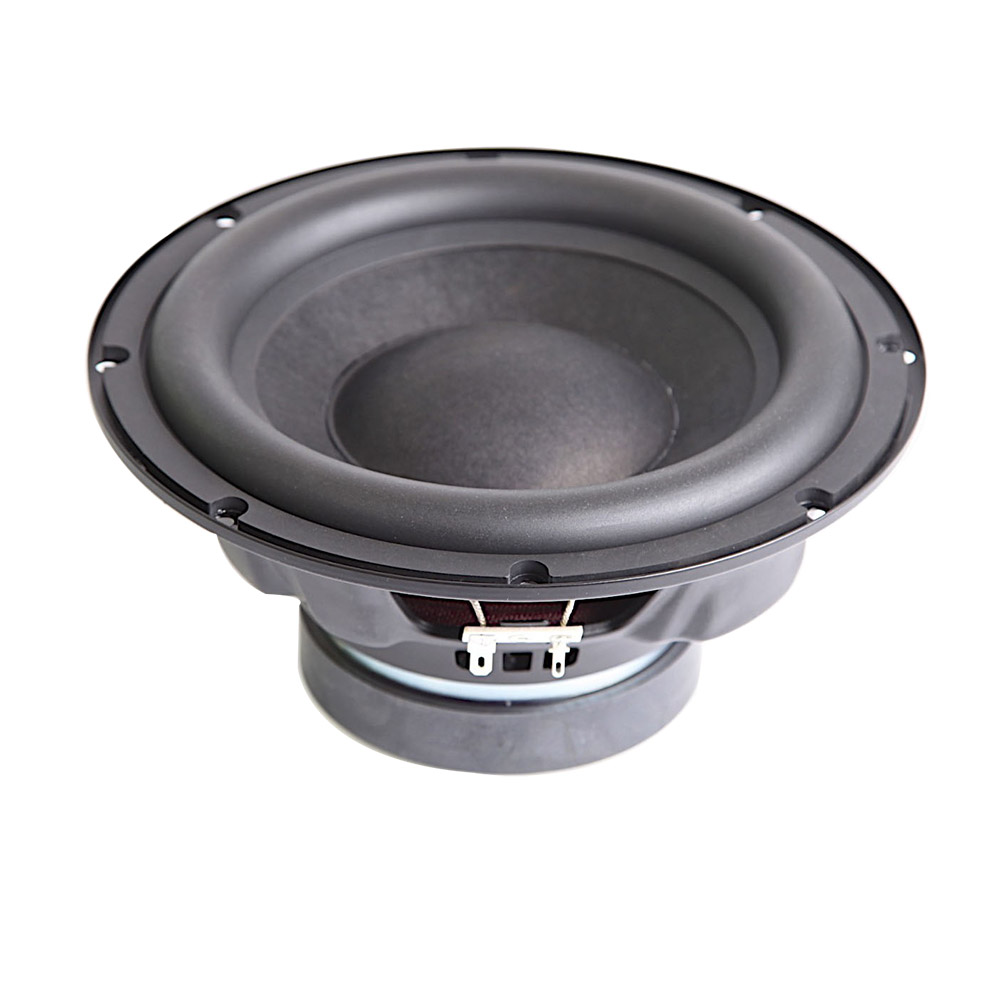
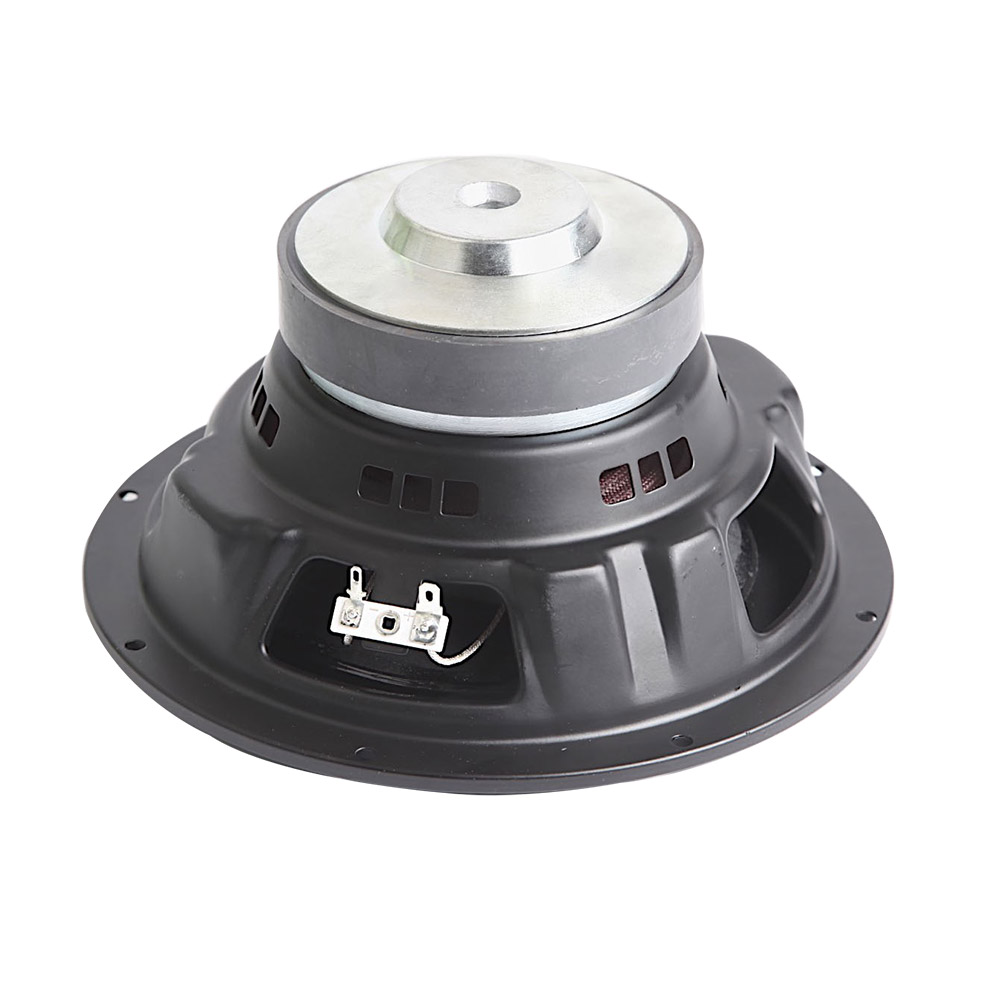
8" | 8FHW
Ferrite Woofer
Key features:
  • Heavy-duty rubber surround and paper cone

  • Ideal for small subwoofers, hi-fi applications

  • High power handling

Design notes:
    • The 8FHW is 8-inch low frequency woofer with linear frequency response characteristics, high power handling capability while generating low harmonic distortion artifacts.The single roll rubber surround design allows the cone to travel in long linear motion. Together with
    • lightweight,yet strong cone,this combination provides remarkable strength, high efficiency and a excursion linearity of 13mm (one direction).Magnetic CircuitREDCATT engineers have developed an efficient, ferrite based magnetic circuit, capable of delivering the
    • high level of performance providing a consistent, high integrity magnetic flux gap, low distortion characteristic. The magnetic circuit design is optimized to generate the minimum amount of flux modulation, providing exceptional stability.
Specifications:
    • General specs
      Nominal Diameter:8 in.
      Rated Impedance:4 Ohm
      Power handling
      AES Power:200 Watts
      Program Power:400 Watts
      Voice Coil
      Diameter:1.4 in.
      Winding wire:Copper
      Former:Aluminum
      Winding height:25.4 mm
    • T/S Parameters
      Resonant frequency:41 Hz
      Re:4 ohm
      Qes:0.75
      Qms:4.2
      Qts:0.6
      Vas:19.6 liters
      Sd:202.3 cm2
      Mms:45.9 grams
      Bl:7.88
      Le:0.72 mH
      Sensitivity:84.4 dB
    • Design details
      Surround Material:Rubber
      Cone material:Paper
      Spider:Conex
      Plate thickness:8 mm
      Peak to peak linear cone Displacement26 mm
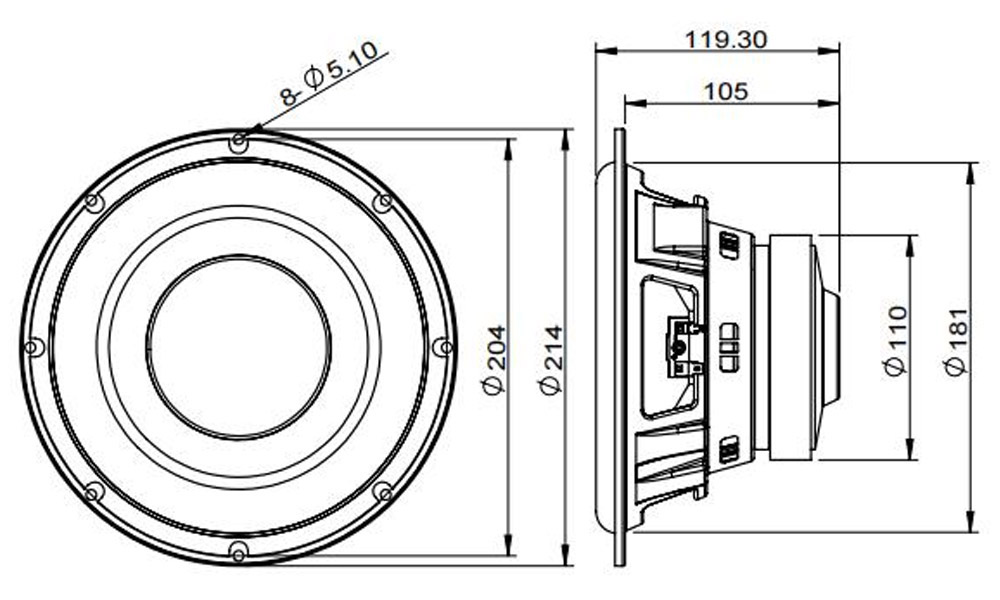
      Overall diameter:214 mm
      Bolt circle diameter:204 mm
      Baffle cutout dia.:181 mm
      Number of mounting holes:8
      Depth (flange to rear):105 mm
      Net weight:2.1 kg
    • Ordering codes:
      4 ohm version:8FHWX4-088
      Recone kits:
      Download:
      Spec download
      2D drawing
      3D model
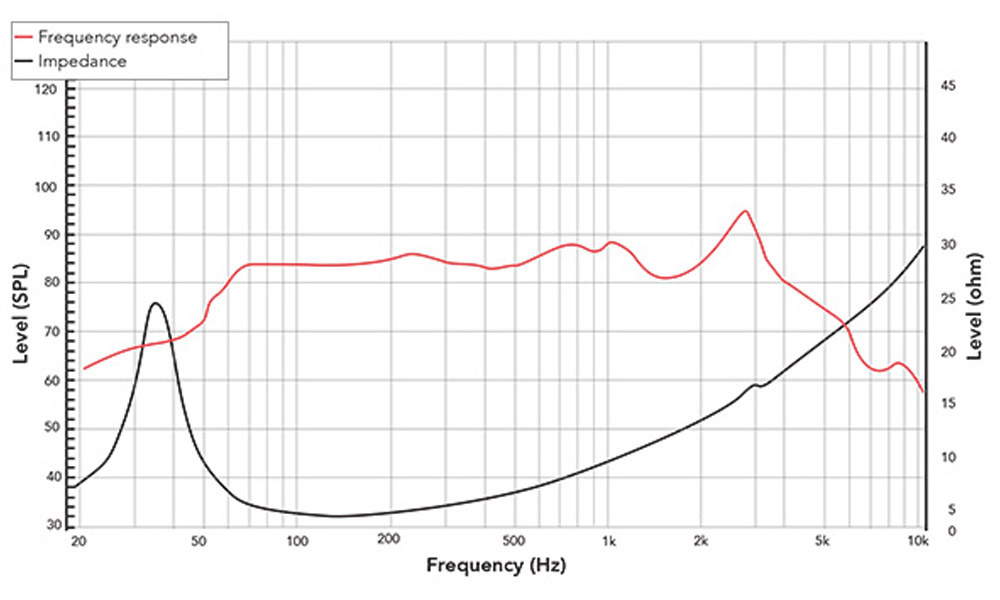
Frequency response & lmpedance
2D drawing

======================================================================

PRODUCT CODE: 8FHWX4-088

======================================================================


--- ENCLOSURE RECOMMENDATIONS ---


======================================================================

ENCLOSURE RECOMMENDATIONS: 8FHWX4-088

======================================================================

Driver: 8FHWX4-088 (8FHW) — 8" Hi-Fi Subwoofer

Key T/S: Fs=41Hz, Qts=0.6, Vas=19.6L, Sens=84.4dB 1W/1m

Power: AES 200W / Cont 400W / Peak 800W

Xmax=8.7mm (one-way linear), Xmech=16.7mm, Sd=202.3cm²

Bl=7.88T·m, Re=4Ω (4-ohm nominal), Mms=45.9g

Voice Coil: 1.4" copper on aluminum former (25.4mm winding height)

Magnet: Ferrite (flux-modulation optimized) | Cone: Paper

Surround: Rubber (single roll, long-excursion) | Spider: Conex


NOTE: With Qts=0.6, high Xmax (8.7mm linear / 16.7mm mechanical),

and Fs=41Hz, this driver is best suited to SEALED hi-fi subwoofer

enclosures. The compliant suspension and moderate Qts produce

well-controlled sealed alignments in practical cabinet volumes.

Vented designs are possible but require very long ports (>500mm) at

these tuning frequencies and cabinet sizes — a passive radiator

alternative is noted below.


======================================================================

  PRIMARY — Sealed Enclosures

======================================================================

Sealed enclosures are the recommended configuration for this driver

in hi-fi subwoofer applications. The smooth, predictable roll-off

below resonance integrates well with room gain (typically +3–6 dB

below 50–60 Hz in domestic rooms), which effectively extends the

in-room response below the anechoic -3dB point.


  a) SEALED — Compact (Qtc ≈ 1.0)

     Net Volume: 11 liters

     System Resonance (fc): 68 Hz

     Qtc: 1.0

     Anechoic -3dB: ~68 Hz

     Estimated in-room -3dB: ~45–50 Hz (with typical room gain)

     Response: Broad lift near resonance (~+3dB peak at fc),

     punchy character with strong upper-bass impact

     Notes: Most compact practical enclosure. The elevated Qtc

     produces a broad resonance peak that adds warmth and punch

     in the 60–80 Hz region. Combined with typical domestic room

     gain, usable in-room response extends well below 50 Hz.

     Well-suited to smaller listening rooms or where cabinet size

     is the primary constraint. Can be EQ'd flat with modest DSP.


  b) SEALED — Balanced/Musical (Qtc ≈ 0.85)

     Net Volume: 20 liters

     System Resonance (fc): 58 Hz

     Qtc: 0.85

     Anechoic -3dB: ~58 Hz

     Estimated in-room -3dB: ~38–42 Hz (with typical room gain)

     Response: Slightly warm, smooth rolloff with gentle lift near fc

     Notes: Excellent all-round hi-fi alignment. The gentle warmth

     near resonance sounds natural and musical, integrating smoothly

     with room acoustics. In-room, this alignment typically delivers

     the most satisfying subjective bass quality without EQ. This is

     the recommended starting point for most hi-fi applications.

     *** RECOMMENDED FOR MOST HI-FI APPLICATIONS ***


  c) SEALED — Extended (Qtc ≈ 0.80)

     Net Volume: 25 liters

     System Resonance (fc): 55 Hz

     Qtc: 0.80

     Anechoic -3dB: ~55 Hz

     Estimated in-room -3dB: ~35–40 Hz (with typical room gain)

     Response: Near-flat amplitude, smooth extended rolloff

     Notes: Larger enclosure with extended low-frequency response.

     The near-Butterworth alignment produces a smooth, accurate

     response with minimal resonance peak. Best for larger listening

     rooms, critical listening applications, or when accurate tonal

     balance is prioritized over maximum output. Pairs well with

     room correction systems (Dirac, Audyssey, etc.).


ROOM GAIN NOTE: In typical domestic rooms (15–40 m²), boundary

reinforcement provides +3–6 dB of gain below 50–60 Hz. Corner

placement adds further gain. This means the effective in-room

-3dB point is significantly lower than the anechoic figure.

Sealed alignments with Qtc 0.8–0.9 typically sound best in-room

because room gain compensates for the gentle rolloff, producing

a naturally flat in-room response.


======================================================================

  SECONDARY — Bass Reflex (Vented) / Passive Radiator

======================================================================

Vented enclosures extend the low-frequency response below what sealed

can achieve in the same volume, but the long port lengths required

(>500mm for a 65mm port) make conventional round ports impractical

for these cabinet sizes. Two practical options are noted below.


OPTION 1: VENTED WITH FOLDED SLOT PORT


  d) VENTED — High Output

     Net Volume: 8 liters

     Tuning (Fb): 47 Hz

     Est. -3dB: 43 Hz

     HP Filter: 37 Hz (24dB/oct recommended)

     Round Port: 65mm dia × 512mm long (impractical — use slot)

     Slot Port: 161mm W × 40mm H × 750mm L (folded internally)

     Port Velocity: 15.7 m/s

     Notes: Compact vented alignment. The slot port must be folded

     inside the cabinet (L-shaped or U-shaped path). Provides

     strong output in the 40–80 Hz region with good excursion

     control near tuning.


  e) VENTED — Balanced

     Net Volume: 9 liters

     Tuning (Fb): 43 Hz

     Est. -3dB: 40 Hz

     HP Filter: 33 Hz (24dB/oct recommended)

     Round Port: 65mm dia × 547mm long (impractical — use slot)

     Slot Port: 161mm W × 40mm H × 800mm L (folded internally)

     Port Velocity: 14.3 m/s

     Notes: Good balance between extension and cabinet size.

     Slot port must be folded. Reaches usably into the low 30s Hz

     in-room with room gain.


  f) VENTED — Extended Low Frequency

     Net Volume: 11 liters

     Tuning (Fb): 39 Hz

     Est. -3dB: 33 Hz

     HP Filter: 29 Hz (24dB/oct recommended)

     Round Port: 65mm dia × 544mm long (impractical — use slot)

     Slot Port: 161mm W × 40mm H × 790mm L (folded internally)

     Port Velocity: 13.0 m/s

     Notes: Maximum extension, reaching into the low 30s Hz

     anechoic and below 30 Hz in-room. Larger cabinet but still

     practical for an 8" hi-fi subwoofer. Requires high-pass

     protection below tuning.


PORT NOTE: All vented alignments require port lengths exceeding

500mm, which is impractical for straight round ports in cabinets

of this size. Folded slot ports (L-shaped or U-shaped internal

ducting) are the practical solution. Ensure the slot port has a

minimum height of 40mm to avoid whistling artifacts.


OPTION 2: PASSIVE RADIATOR (Recommended Alternative to Vented)


A passive radiator (PR) eliminates the long port entirely and

provides the same acoustic loading in a compact, sealed-looking

enclosure. The PR should have:

  - Sd approximately equal to the active driver (~200 cm²)

  - Tuning mass selected to achieve the desired Fb (39–47 Hz)

  - Compliance similar to or higher than the active driver

  - Xmax equal to or greater than the active driver (≥8.7mm)


A passive radiator configuration in 8–11 liters tuned to 40–45 Hz

provides deep, clean bass extension without the port noise and

length constraints of a vented design. This is the preferred

approach for modern compact hi-fi subwoofers.


EXCURSION NOTE: The 8FHW has substantial linear excursion (8.7mm)

with further mechanical clearance to 16.7mm. This provides significant

displacement capability (Vd = 176 cc) for an 8" driver, supporting

meaningful output to low frequencies. However, below the tuning

frequency in vented/PR configurations, excursion rises rapidly —

a subsonic high-pass filter is essential.


The 8FHWX4-088 is an 8-inch ferrite woofer designed for hi-fi subwoofer and home audio applications requiring deep bass extension, high excursion linearity, and low harmonic distortion. It features a 1.4-inch copper voice coil on an aluminum former with 25.4 mm winding height, a lightweight paper cone with a long-excursion single-roll rubber surround, and a ferrite motor circuit optimized for minimum flux modulation and low distortion. With 8.7 mm of linear excursion (16.7 mm mechanical), 200 W AES / 400 W continuous power handling, and a 4-ohm nominal impedance, the driver provides substantial low-frequency displacement capability for its size class.


In sealed enclosures, the driver's Qts of 0.6 produces well-controlled alignments in net internal volumes of 11 to 25 liters. A compact 11-liter sealed enclosure (Qtc 1.0, fc 68 Hz) provides a punchy, space-efficient design that relies on room gain for in-room extension below 50 Hz. A 20-liter sealed enclosure (Qtc 0.85, fc 58 Hz) is the recommended starting point for most hi-fi applications, producing a warm, musical response with estimated in-room extension to 38–42 Hz in typical domestic listening rooms. A 25-liter enclosure (Qtc 0.80, fc 55 Hz) extends the anechoic response further and provides near-flat amplitude for critical listening applications. In all sealed alignments, typical domestic room gain (+3–6 dB below 50–60 Hz) significantly extends the effective in-room bass response below the anechoic -3 dB point.


For applications requiring deeper anechoic extension, vented or passive radiator configurations in 8 to 11 liters tuned between 39 and 47 Hz extend the -3 dB point to approximately 33–43 Hz. Port lengths exceed 500 mm at these tuning frequencies, making folded slot ports or passive radiators the practical implementation choices. A passive radiator of similar Sd and excursion capability, tuned to 40–45 Hz, provides clean bass extension without port noise artifacts and is the recommended alternative to vented loading for compact hi-fi subwoofer enclosures.


This driver is particularly effective in compact sealed and passive-radiator hi-fi subwoofers, bookshelf-paired bass modules, and home theater systems where deep, controlled bass from a small enclosure is required. The flux-modulation-optimized ferrite motor, long-excursion rubber surround, and high mechanical clearance (16.7 mm) provide consistent, low-distortion performance across the driver's full excursion range.


──────────────────────────────────────────────────────────────────────

======================================================================

PRODUCT CODE: 8FHWX4-088

======================================================================


--- ENCLOSURE RECOMMENDATIONS ---


======================================================================

ENCLOSURE RECOMMENDATIONS: 8FHWX4-088

======================================================================

Driver: 8FHWX4-088 (8FHW) — 8" Hi-Fi Subwoofer

Key T/S: Fs=41Hz, Qts=0.6, Vas=19.6L, Sens=84.4dB 1W/1m

Power: AES 200W / Cont 400W / Peak 800W

Xmax=8.7mm (one-way linear), Xmech=16.7mm, Sd=202.3cm²

Bl=7.88T·m, Re=4Ω (4-ohm nominal), Mms=45.9g

Voice Coil: 1.4" copper on aluminum former (25.4mm winding height)

Magnet: Ferrite (flux-modulation optimized) | Cone: Paper

Surround: Rubber (single roll, long-excursion) | Spider: Conex


NOTE: With Qts=0.6, high Xmax (8.7mm linear / 16.7mm mechanical),

and Fs=41Hz, this driver is best suited to SEALED hi-fi subwoofer

enclosures. The compliant suspension and moderate Qts produce

well-controlled sealed alignments in practical cabinet volumes.

Vented designs are possible but require very long ports (>500mm) at

these tuning frequencies and cabinet sizes — a passive radiator

alternative is noted below.


======================================================================

  PRIMARY — Sealed Enclosures

======================================================================

Sealed enclosures are the recommended configuration for this driver

in hi-fi subwoofer applications. The smooth, predictable roll-off

below resonance integrates well with room gain (typically +3–6 dB

below 50–60 Hz in domestic rooms), which effectively extends the

in-room response below the anechoic -3dB point.


  a) SEALED — Compact (Qtc ≈ 1.0)

     Net Volume: 11 liters

     System Resonance (fc): 68 Hz

     Qtc: 1.0

     Anechoic -3dB: ~68 Hz

     Estimated in-room -3dB: ~45–50 Hz (with typical room gain)

     Response: Broad lift near resonance (~+3dB peak at fc),

     punchy character with strong upper-bass impact

     Notes: Most compact practical enclosure. The elevated Qtc

     produces a broad resonance peak that adds warmth and punch

     in the 60–80 Hz region. Combined with typical domestic room

     gain, usable in-room response extends well below 50 Hz.

     Well-suited to smaller listening rooms or where cabinet size

     is the primary constraint. Can be EQ'd flat with modest DSP.


  b) SEALED — Balanced/Musical (Qtc ≈ 0.85)

     Net Volume: 20 liters

     System Resonance (fc): 58 Hz

     Qtc: 0.85

     Anechoic -3dB: ~58 Hz

     Estimated in-room -3dB: ~38–42 Hz (with typical room gain)

     Response: Slightly warm, smooth rolloff with gentle lift near fc

     Notes: Excellent all-round hi-fi alignment. The gentle warmth

     near resonance sounds natural and musical, integrating smoothly

     with room acoustics. In-room, this alignment typically delivers

     the most satisfying subjective bass quality without EQ. This is

     the recommended starting point for most hi-fi applications.

     *** RECOMMENDED FOR MOST HI-FI APPLICATIONS ***


  c) SEALED — Extended (Qtc ≈ 0.80)

     Net Volume: 25 liters

     System Resonance (fc): 55 Hz

     Qtc: 0.80

     Anechoic -3dB: ~55 Hz

     Estimated in-room -3dB: ~35–40 Hz (with typical room gain)

     Response: Near-flat amplitude, smooth extended rolloff

     Notes: Larger enclosure with extended low-frequency response.

     The near-Butterworth alignment produces a smooth, accurate

     response with minimal resonance peak. Best for larger listening

     rooms, critical listening applications, or when accurate tonal

     balance is prioritized over maximum output. Pairs well with

     room correction systems (Dirac, Audyssey, etc.).


ROOM GAIN NOTE: In typical domestic rooms (15–40 m²), boundary

reinforcement provides +3–6 dB of gain below 50–60 Hz. Corner

placement adds further gain. This means the effective in-room

-3dB point is significantly lower than the anechoic figure.

Sealed alignments with Qtc 0.8–0.9 typically sound best in-room

because room gain compensates for the gentle rolloff, producing

a naturally flat in-room response.


======================================================================

  SECONDARY — Bass Reflex (Vented) / Passive Radiator

======================================================================

Vented enclosures extend the low-frequency response below what sealed

can achieve in the same volume, but the long port lengths required

(>500mm for a 65mm port) make conventional round ports impractical

for these cabinet sizes. Two practical options are noted below.


OPTION 1: VENTED WITH FOLDED SLOT PORT


  d) VENTED — High Output

     Net Volume: 8 liters

     Tuning (Fb): 47 Hz

     Est. -3dB: 43 Hz

     HP Filter: 37 Hz (24dB/oct recommended)

     Round Port: 65mm dia × 512mm long (impractical — use slot)

     Slot Port: 161mm W × 40mm H × 750mm L (folded internally)

     Port Velocity: 15.7 m/s

     Notes: Compact vented alignment. The slot port must be folded

     inside the cabinet (L-shaped or U-shaped path). Provides

     strong output in the 40–80 Hz region with good excursion

     control near tuning.


  e) VENTED — Balanced

     Net Volume: 9 liters

     Tuning (Fb): 43 Hz

     Est. -3dB: 40 Hz

     HP Filter: 33 Hz (24dB/oct recommended)

     Round Port: 65mm dia × 547mm long (impractical — use slot)

     Slot Port: 161mm W × 40mm H × 800mm L (folded internally)

     Port Velocity: 14.3 m/s

     Notes: Good balance between extension and cabinet size.

     Slot port must be folded. Reaches usably into the low 30s Hz

     in-room with room gain.


  f) VENTED — Extended Low Frequency

     Net Volume: 11 liters

     Tuning (Fb): 39 Hz

     Est. -3dB: 33 Hz

     HP Filter: 29 Hz (24dB/oct recommended)

     Round Port: 65mm dia × 544mm long (impractical — use slot)

     Slot Port: 161mm W × 40mm H × 790mm L (folded internally)

     Port Velocity: 13.0 m/s

     Notes: Maximum extension, reaching into the low 30s Hz

     anechoic and below 30 Hz in-room. Larger cabinet but still

     practical for an 8" hi-fi subwoofer. Requires high-pass

     protection below tuning.


PORT NOTE: All vented alignments require port lengths exceeding

500mm, which is impractical for straight round ports in cabinets

of this size. Folded slot ports (L-shaped or U-shaped internal

ducting) are the practical solution. Ensure the slot port has a

minimum height of 40mm to avoid whistling artifacts.


OPTION 2: PASSIVE RADIATOR (Recommended Alternative to Vented)


A passive radiator (PR) eliminates the long port entirely and

provides the same acoustic loading in a compact, sealed-looking

enclosure. The PR should have:

  - Sd approximately equal to the active driver (~200 cm²)

  - Tuning mass selected to achieve the desired Fb (39–47 Hz)

  - Compliance similar to or higher than the active driver

  - Xmax equal to or greater than the active driver (≥8.7mm)


A passive radiator configuration in 8–11 liters tuned to 40–45 Hz

provides deep, clean bass extension without the port noise and

length constraints of a vented design. This is the preferred

approach for modern compact hi-fi subwoofers.


EXCURSION NOTE: The 8FHW has substantial linear excursion (8.7mm)

with further mechanical clearance to 16.7mm. This provides significant

displacement capability (Vd = 176 cc) for an 8" driver, supporting

meaningful output to low frequencies. However, below the tuning

frequency in vented/PR configurations, excursion rises rapidly —

a subsonic high-pass filter is essential.


The 8FHWX4-088 is an 8-inch ferrite woofer designed for hi-fi subwoofer and home audio applications requiring deep bass extension, high excursion linearity, and low harmonic distortion. It features a 1.4-inch copper voice coil on an aluminum former with 25.4 mm winding height, a lightweight paper cone with a long-excursion single-roll rubber surround, and a ferrite motor circuit optimized for minimum flux modulation and low distortion. With 8.7 mm of linear excursion (16.7 mm mechanical), 200 W AES / 400 W continuous power handling, and a 4-ohm nominal impedance, the driver provides substantial low-frequency displacement capability for its size class.


In sealed enclosures, the driver's Qts of 0.6 produces well-controlled alignments in net internal volumes of 11 to 25 liters. A compact 11-liter sealed enclosure (Qtc 1.0, fc 68 Hz) provides a punchy, space-efficient design that relies on room gain for in-room extension below 50 Hz. A 20-liter sealed enclosure (Qtc 0.85, fc 58 Hz) is the recommended starting point for most hi-fi applications, producing a warm, musical response with estimated in-room extension to 38–42 Hz in typical domestic listening rooms. A 25-liter enclosure (Qtc 0.80, fc 55 Hz) extends the anechoic response further and provides near-flat amplitude for critical listening applications. In all sealed alignments, typical domestic room gain (+3–6 dB below 50–60 Hz) significantly extends the effective in-room bass response below the anechoic -3 dB point.


For applications requiring deeper anechoic extension, vented or passive radiator configurations in 8 to 11 liters tuned between 39 and 47 Hz extend the -3 dB point to approximately 33–43 Hz. Port lengths exceed 500 mm at these tuning frequencies, making folded slot ports or passive radiators the practical implementation choices. A passive radiator of similar Sd and excursion capability, tuned to 40–45 Hz, provides clean bass extension without port noise artifacts and is the recommended alternative to vented loading for compact hi-fi subwoofer enclosures.


This driver is particularly effective in compact sealed and passive-radiator hi-fi subwoofers, bookshelf-paired bass modules, and home theater systems where deep, controlled bass from a small enclosure is required. The flux-modulation-optimized ferrite motor, long-excursion rubber surround, and high mechanical clearance (16.7 mm) provide consistent, low-distortion performance across the driver's full excursion range.


──────────────────────────────────────────────────────────────────────

redcatt
Redcatt

REDCATT IS THE PARTNER OF CHOICE
REDCATT designs and manufactures world class loudspeakers. Additionally to the loudspeakers sold under REDCATT brand name, we also design and manufacture OEM / ODM loudspeakers.
Copyright © 2012-2026 REDCATT Technology CO., LTD. All Rights Reserved
<<

Back

Back Top

HOME

HOME
ABOUT

ABOUT

ABOUT
PRODUCTS

PRODUCTS

PRODUCTS
TECHNOLOGY

TECHNOLOGY

TECHNOLOGY
QUALITY

QUALITY

QUALITY
CONTACT

CONTACT

CONTACT

CX6F-140F
Ferrite Woofer
8" | 8FHW
Key features:
  • Heavy-duty rubber surround and paper cone

  • Ideal for small subwoofers, hi-fi applications

  • High power handling

Design notes:

The 8FHW is 8-inch low frequency woofer with linear frequency response characteristics, high power handling capability while generating low harmonic distortion artifacts.The single roll rubber surround design allows the cone to travel in long linear motion. Together with lightweight,yet strong cone,this combination provides remarkable strength, high efficiency and a excursion linearity of 13mm (one direction).Magnetic CircuitREDCATT engineers have developed an efficient, ferrite based magnetic circuit, capable of delivering the high level of performance providing a consistent, high integrity magnetic flux gap, low distortion characteristic. The magnetic circuit design is optimized to generate the minimum amount of flux modulation, providing exceptional stability.

Specifications:
General specs
Nominal Diameter:8 in.
Rated Impedance:4 Ohm
Power handling
AES Power:200 Watts
Program Power:400 Watts
Voice Coil
Diameter:1.4 in.
Winding wire:Copper
Former:Aluminum
Winding height:25.4 mm
T/S Parameters
Resonant frequency:41 Hz
Re:4 ohm
Qes:0.75
Qms:4.2
Qts:0.6
Vas:19.6 liters
Sd:202.3 cm2
Mms:45.9 grams
Bl:7.88
Le:0.72 mH
Sensitivity:84.4 dB
Design details
Surround Material:Rubber
Cone material:Paper
Spider:Conex
Plate thickness:8 mm
Peak to peak linear cone Displacement26 mm
Overall diameter:214 mm
Bolt circle diameter:204 mm
Baffle cutout dia.:181 mm
Number of mounting holes:8
Depth (flange to rear):105 mm
Net weight:2.1 kg
Ordering codes:
4 ohm version:8FHWX4-088
Recone kits:


Download:
Spec download
2D drawing
3D model
Frequency response & lmpedance
2D drawing

======================================================================

PRODUCT CODE: 8FHWX4-088

======================================================================


--- ENCLOSURE RECOMMENDATIONS ---


======================================================================

ENCLOSURE RECOMMENDATIONS: 8FHWX4-088

======================================================================

Driver: 8FHWX4-088 (8FHW) — 8" Hi-Fi Subwoofer

Key T/S: Fs=41Hz, Qts=0.6, Vas=19.6L, Sens=84.4dB 1W/1m

Power: AES 200W / Cont 400W / Peak 800W

Xmax=8.7mm (one-way linear), Xmech=16.7mm, Sd=202.3cm²

Bl=7.88T·m, Re=4Ω (4-ohm nominal), Mms=45.9g

Voice Coil: 1.4" copper on aluminum former (25.4mm winding height)

Magnet: Ferrite (flux-modulation optimized) | Cone: Paper

Surround: Rubber (single roll, long-excursion) | Spider: Conex


NOTE: With Qts=0.6, high Xmax (8.7mm linear / 16.7mm mechanical),

and Fs=41Hz, this driver is best suited to SEALED hi-fi subwoofer

enclosures. The compliant suspension and moderate Qts produce

well-controlled sealed alignments in practical cabinet volumes.

Vented designs are possible but require very long ports (>500mm) at

these tuning frequencies and cabinet sizes — a passive radiator

alternative is noted below.


======================================================================

  PRIMARY — Sealed Enclosures

======================================================================

Sealed enclosures are the recommended configuration for this driver

in hi-fi subwoofer applications. The smooth, predictable roll-off

below resonance integrates well with room gain (typically +3–6 dB

below 50–60 Hz in domestic rooms), which effectively extends the

in-room response below the anechoic -3dB point.


  a) SEALED — Compact (Qtc ≈ 1.0)

     Net Volume: 11 liters

     System Resonance (fc): 68 Hz

     Qtc: 1.0

     Anechoic -3dB: ~68 Hz

     Estimated in-room -3dB: ~45–50 Hz (with typical room gain)

     Response: Broad lift near resonance (~+3dB peak at fc),

     punchy character with strong upper-bass impact

     Notes: Most compact practical enclosure. The elevated Qtc

     produces a broad resonance peak that adds warmth and punch

     in the 60–80 Hz region. Combined with typical domestic room

     gain, usable in-room response extends well below 50 Hz.

     Well-suited to smaller listening rooms or where cabinet size

     is the primary constraint. Can be EQ'd flat with modest DSP.


  b) SEALED — Balanced/Musical (Qtc ≈ 0.85)

     Net Volume: 20 liters

     System Resonance (fc): 58 Hz

     Qtc: 0.85

     Anechoic -3dB: ~58 Hz

     Estimated in-room -3dB: ~38–42 Hz (with typical room gain)

     Response: Slightly warm, smooth rolloff with gentle lift near fc

     Notes: Excellent all-round hi-fi alignment. The gentle warmth

     near resonance sounds natural and musical, integrating smoothly

     with room acoustics. In-room, this alignment typically delivers

     the most satisfying subjective bass quality without EQ. This is

     the recommended starting point for most hi-fi applications.

     *** RECOMMENDED FOR MOST HI-FI APPLICATIONS ***


  c) SEALED — Extended (Qtc ≈ 0.80)

     Net Volume: 25 liters

     System Resonance (fc): 55 Hz

     Qtc: 0.80

     Anechoic -3dB: ~55 Hz

     Estimated in-room -3dB: ~35–40 Hz (with typical room gain)

     Response: Near-flat amplitude, smooth extended rolloff

     Notes: Larger enclosure with extended low-frequency response.

     The near-Butterworth alignment produces a smooth, accurate

     response with minimal resonance peak. Best for larger listening

     rooms, critical listening applications, or when accurate tonal

     balance is prioritized over maximum output. Pairs well with

     room correction systems (Dirac, Audyssey, etc.).


ROOM GAIN NOTE: In typical domestic rooms (15–40 m²), boundary

reinforcement provides +3–6 dB of gain below 50–60 Hz. Corner

placement adds further gain. This means the effective in-room

-3dB point is significantly lower than the anechoic figure.

Sealed alignments with Qtc 0.8–0.9 typically sound best in-room

because room gain compensates for the gentle rolloff, producing

a naturally flat in-room response.


======================================================================

  SECONDARY — Bass Reflex (Vented) / Passive Radiator

======================================================================

Vented enclosures extend the low-frequency response below what sealed

can achieve in the same volume, but the long port lengths required

(>500mm for a 65mm port) make conventional round ports impractical

for these cabinet sizes. Two practical options are noted below.


OPTION 1: VENTED WITH FOLDED SLOT PORT


  d) VENTED — High Output

     Net Volume: 8 liters

     Tuning (Fb): 47 Hz

     Est. -3dB: 43 Hz

     HP Filter: 37 Hz (24dB/oct recommended)

     Round Port: 65mm dia × 512mm long (impractical — use slot)

     Slot Port: 161mm W × 40mm H × 750mm L (folded internally)

     Port Velocity: 15.7 m/s

     Notes: Compact vented alignment. The slot port must be folded

     inside the cabinet (L-shaped or U-shaped path). Provides

     strong output in the 40–80 Hz region with good excursion

     control near tuning.


  e) VENTED — Balanced

     Net Volume: 9 liters

     Tuning (Fb): 43 Hz

     Est. -3dB: 40 Hz

     HP Filter: 33 Hz (24dB/oct recommended)

     Round Port: 65mm dia × 547mm long (impractical — use slot)

     Slot Port: 161mm W × 40mm H × 800mm L (folded internally)

     Port Velocity: 14.3 m/s

     Notes: Good balance between extension and cabinet size.

     Slot port must be folded. Reaches usably into the low 30s Hz

     in-room with room gain.


  f) VENTED — Extended Low Frequency

     Net Volume: 11 liters

     Tuning (Fb): 39 Hz

     Est. -3dB: 33 Hz

     HP Filter: 29 Hz (24dB/oct recommended)

     Round Port: 65mm dia × 544mm long (impractical — use slot)

     Slot Port: 161mm W × 40mm H × 790mm L (folded internally)

     Port Velocity: 13.0 m/s

     Notes: Maximum extension, reaching into the low 30s Hz

     anechoic and below 30 Hz in-room. Larger cabinet but still

     practical for an 8" hi-fi subwoofer. Requires high-pass

     protection below tuning.


PORT NOTE: All vented alignments require port lengths exceeding

500mm, which is impractical for straight round ports in cabinets

of this size. Folded slot ports (L-shaped or U-shaped internal

ducting) are the practical solution. Ensure the slot port has a

minimum height of 40mm to avoid whistling artifacts.


OPTION 2: PASSIVE RADIATOR (Recommended Alternative to Vented)


A passive radiator (PR) eliminates the long port entirely and

provides the same acoustic loading in a compact, sealed-looking

enclosure. The PR should have:

  - Sd approximately equal to the active driver (~200 cm²)

  - Tuning mass selected to achieve the desired Fb (39–47 Hz)

  - Compliance similar to or higher than the active driver

  - Xmax equal to or greater than the active driver (≥8.7mm)


A passive radiator configuration in 8–11 liters tuned to 40–45 Hz

provides deep, clean bass extension without the port noise and

length constraints of a vented design. This is the preferred

approach for modern compact hi-fi subwoofers.


EXCURSION NOTE: The 8FHW has substantial linear excursion (8.7mm)

with further mechanical clearance to 16.7mm. This provides significant

displacement capability (Vd = 176 cc) for an 8" driver, supporting

meaningful output to low frequencies. However, below the tuning

frequency in vented/PR configurations, excursion rises rapidly —

a subsonic high-pass filter is essential.


The 8FHWX4-088 is an 8-inch ferrite woofer designed for hi-fi subwoofer and home audio applications requiring deep bass extension, high excursion linearity, and low harmonic distortion. It features a 1.4-inch copper voice coil on an aluminum former with 25.4 mm winding height, a lightweight paper cone with a long-excursion single-roll rubber surround, and a ferrite motor circuit optimized for minimum flux modulation and low distortion. With 8.7 mm of linear excursion (16.7 mm mechanical), 200 W AES / 400 W continuous power handling, and a 4-ohm nominal impedance, the driver provides substantial low-frequency displacement capability for its size class.


In sealed enclosures, the driver's Qts of 0.6 produces well-controlled alignments in net internal volumes of 11 to 25 liters. A compact 11-liter sealed enclosure (Qtc 1.0, fc 68 Hz) provides a punchy, space-efficient design that relies on room gain for in-room extension below 50 Hz. A 20-liter sealed enclosure (Qtc 0.85, fc 58 Hz) is the recommended starting point for most hi-fi applications, producing a warm, musical response with estimated in-room extension to 38–42 Hz in typical domestic listening rooms. A 25-liter enclosure (Qtc 0.80, fc 55 Hz) extends the anechoic response further and provides near-flat amplitude for critical listening applications. In all sealed alignments, typical domestic room gain (+3–6 dB below 50–60 Hz) significantly extends the effective in-room bass response below the anechoic -3 dB point.


For applications requiring deeper anechoic extension, vented or passive radiator configurations in 8 to 11 liters tuned between 39 and 47 Hz extend the -3 dB point to approximately 33–43 Hz. Port lengths exceed 500 mm at these tuning frequencies, making folded slot ports or passive radiators the practical implementation choices. A passive radiator of similar Sd and excursion capability, tuned to 40–45 Hz, provides clean bass extension without port noise artifacts and is the recommended alternative to vented loading for compact hi-fi subwoofer enclosures.


This driver is particularly effective in compact sealed and passive-radiator hi-fi subwoofers, bookshelf-paired bass modules, and home theater systems where deep, controlled bass from a small enclosure is required. The flux-modulation-optimized ferrite motor, long-excursion rubber surround, and high mechanical clearance (16.7 mm) provide consistent, low-distortion performance across the driver's full excursion range.


──────────────────────────────────────────────────────────────────────

======================================================================

PRODUCT CODE: 8FHWX4-088

======================================================================


--- ENCLOSURE RECOMMENDATIONS ---


======================================================================

ENCLOSURE RECOMMENDATIONS: 8FHWX4-088

======================================================================

Driver: 8FHWX4-088 (8FHW) — 8" Hi-Fi Subwoofer

Key T/S: Fs=41Hz, Qts=0.6, Vas=19.6L, Sens=84.4dB 1W/1m

Power: AES 200W / Cont 400W / Peak 800W

Xmax=8.7mm (one-way linear), Xmech=16.7mm, Sd=202.3cm²

Bl=7.88T·m, Re=4Ω (4-ohm nominal), Mms=45.9g

Voice Coil: 1.4" copper on aluminum former (25.4mm winding height)

Magnet: Ferrite (flux-modulation optimized) | Cone: Paper

Surround: Rubber (single roll, long-excursion) | Spider: Conex


NOTE: With Qts=0.6, high Xmax (8.7mm linear / 16.7mm mechanical),

and Fs=41Hz, this driver is best suited to SEALED hi-fi subwoofer

enclosures. The compliant suspension and moderate Qts produce

well-controlled sealed alignments in practical cabinet volumes.

Vented designs are possible but require very long ports (>500mm) at

these tuning frequencies and cabinet sizes — a passive radiator

alternative is noted below.


======================================================================

  PRIMARY — Sealed Enclosures

======================================================================

Sealed enclosures are the recommended configuration for this driver

in hi-fi subwoofer applications. The smooth, predictable roll-off

below resonance integrates well with room gain (typically +3–6 dB

below 50–60 Hz in domestic rooms), which effectively extends the

in-room response below the anechoic -3dB point.


  a) SEALED — Compact (Qtc ≈ 1.0)

     Net Volume: 11 liters

     System Resonance (fc): 68 Hz

     Qtc: 1.0

     Anechoic -3dB: ~68 Hz

     Estimated in-room -3dB: ~45–50 Hz (with typical room gain)

     Response: Broad lift near resonance (~+3dB peak at fc),

     punchy character with strong upper-bass impact

     Notes: Most compact practical enclosure. The elevated Qtc

     produces a broad resonance peak that adds warmth and punch

     in the 60–80 Hz region. Combined with typical domestic room

     gain, usable in-room response extends well below 50 Hz.

     Well-suited to smaller listening rooms or where cabinet size

     is the primary constraint. Can be EQ'd flat with modest DSP.


  b) SEALED — Balanced/Musical (Qtc ≈ 0.85)

     Net Volume: 20 liters

     System Resonance (fc): 58 Hz

     Qtc: 0.85

     Anechoic -3dB: ~58 Hz

     Estimated in-room -3dB: ~38–42 Hz (with typical room gain)

     Response: Slightly warm, smooth rolloff with gentle lift near fc

     Notes: Excellent all-round hi-fi alignment. The gentle warmth

     near resonance sounds natural and musical, integrating smoothly

     with room acoustics. In-room, this alignment typically delivers

     the most satisfying subjective bass quality without EQ. This is

     the recommended starting point for most hi-fi applications.

     *** RECOMMENDED FOR MOST HI-FI APPLICATIONS ***


  c) SEALED — Extended (Qtc ≈ 0.80)

     Net Volume: 25 liters

     System Resonance (fc): 55 Hz

     Qtc: 0.80

     Anechoic -3dB: ~55 Hz

     Estimated in-room -3dB: ~35–40 Hz (with typical room gain)

     Response: Near-flat amplitude, smooth extended rolloff

     Notes: Larger enclosure with extended low-frequency response.

     The near-Butterworth alignment produces a smooth, accurate

     response with minimal resonance peak. Best for larger listening

     rooms, critical listening applications, or when accurate tonal

     balance is prioritized over maximum output. Pairs well with

     room correction systems (Dirac, Audyssey, etc.).


ROOM GAIN NOTE: In typical domestic rooms (15–40 m²), boundary

reinforcement provides +3–6 dB of gain below 50–60 Hz. Corner

placement adds further gain. This means the effective in-room

-3dB point is significantly lower than the anechoic figure.

Sealed alignments with Qtc 0.8–0.9 typically sound best in-room

because room gain compensates for the gentle rolloff, producing

a naturally flat in-room response.


======================================================================

  SECONDARY — Bass Reflex (Vented) / Passive Radiator

======================================================================

Vented enclosures extend the low-frequency response below what sealed

can achieve in the same volume, but the long port lengths required

(>500mm for a 65mm port) make conventional round ports impractical

for these cabinet sizes. Two practical options are noted below.


OPTION 1: VENTED WITH FOLDED SLOT PORT


  d) VENTED — High Output

     Net Volume: 8 liters

     Tuning (Fb): 47 Hz

     Est. -3dB: 43 Hz

     HP Filter: 37 Hz (24dB/oct recommended)

     Round Port: 65mm dia × 512mm long (impractical — use slot)

     Slot Port: 161mm W × 40mm H × 750mm L (folded internally)

     Port Velocity: 15.7 m/s

     Notes: Compact vented alignment. The slot port must be folded

     inside the cabinet (L-shaped or U-shaped path). Provides

     strong output in the 40–80 Hz region with good excursion

     control near tuning.


  e) VENTED — Balanced

     Net Volume: 9 liters

     Tuning (Fb): 43 Hz

     Est. -3dB: 40 Hz

     HP Filter: 33 Hz (24dB/oct recommended)

     Round Port: 65mm dia × 547mm long (impractical — use slot)

     Slot Port: 161mm W × 40mm H × 800mm L (folded internally)

     Port Velocity: 14.3 m/s

     Notes: Good balance between extension and cabinet size.

     Slot port must be folded. Reaches usably into the low 30s Hz

     in-room with room gain.


  f) VENTED — Extended Low Frequency

     Net Volume: 11 liters

     Tuning (Fb): 39 Hz

     Est. -3dB: 33 Hz

     HP Filter: 29 Hz (24dB/oct recommended)

     Round Port: 65mm dia × 544mm long (impractical — use slot)

     Slot Port: 161mm W × 40mm H × 790mm L (folded internally)

     Port Velocity: 13.0 m/s

     Notes: Maximum extension, reaching into the low 30s Hz

     anechoic and below 30 Hz in-room. Larger cabinet but still

     practical for an 8" hi-fi subwoofer. Requires high-pass

     protection below tuning.


PORT NOTE: All vented alignments require port lengths exceeding

500mm, which is impractical for straight round ports in cabinets

of this size. Folded slot ports (L-shaped or U-shaped internal

ducting) are the practical solution. Ensure the slot port has a

minimum height of 40mm to avoid whistling artifacts.


OPTION 2: PASSIVE RADIATOR (Recommended Alternative to Vented)


A passive radiator (PR) eliminates the long port entirely and

provides the same acoustic loading in a compact, sealed-looking

enclosure. The PR should have:

  - Sd approximately equal to the active driver (~200 cm²)

  - Tuning mass selected to achieve the desired Fb (39–47 Hz)

  - Compliance similar to or higher than the active driver

  - Xmax equal to or greater than the active driver (≥8.7mm)


A passive radiator configuration in 8–11 liters tuned to 40–45 Hz

provides deep, clean bass extension without the port noise and

length constraints of a vented design. This is the preferred

approach for modern compact hi-fi subwoofers.


EXCURSION NOTE: The 8FHW has substantial linear excursion (8.7mm)

with further mechanical clearance to 16.7mm. This provides significant

displacement capability (Vd = 176 cc) for an 8" driver, supporting

meaningful output to low frequencies. However, below the tuning

frequency in vented/PR configurations, excursion rises rapidly —

a subsonic high-pass filter is essential.


The 8FHWX4-088 is an 8-inch ferrite woofer designed for hi-fi subwoofer and home audio applications requiring deep bass extension, high excursion linearity, and low harmonic distortion. It features a 1.4-inch copper voice coil on an aluminum former with 25.4 mm winding height, a lightweight paper cone with a long-excursion single-roll rubber surround, and a ferrite motor circuit optimized for minimum flux modulation and low distortion. With 8.7 mm of linear excursion (16.7 mm mechanical), 200 W AES / 400 W continuous power handling, and a 4-ohm nominal impedance, the driver provides substantial low-frequency displacement capability for its size class.


In sealed enclosures, the driver's Qts of 0.6 produces well-controlled alignments in net internal volumes of 11 to 25 liters. A compact 11-liter sealed enclosure (Qtc 1.0, fc 68 Hz) provides a punchy, space-efficient design that relies on room gain for in-room extension below 50 Hz. A 20-liter sealed enclosure (Qtc 0.85, fc 58 Hz) is the recommended starting point for most hi-fi applications, producing a warm, musical response with estimated in-room extension to 38–42 Hz in typical domestic listening rooms. A 25-liter enclosure (Qtc 0.80, fc 55 Hz) extends the anechoic response further and provides near-flat amplitude for critical listening applications. In all sealed alignments, typical domestic room gain (+3–6 dB below 50–60 Hz) significantly extends the effective in-room bass response below the anechoic -3 dB point.


For applications requiring deeper anechoic extension, vented or passive radiator configurations in 8 to 11 liters tuned between 39 and 47 Hz extend the -3 dB point to approximately 33–43 Hz. Port lengths exceed 500 mm at these tuning frequencies, making folded slot ports or passive radiators the practical implementation choices. A passive radiator of similar Sd and excursion capability, tuned to 40–45 Hz, provides clean bass extension without port noise artifacts and is the recommended alternative to vented loading for compact hi-fi subwoofer enclosures.


This driver is particularly effective in compact sealed and passive-radiator hi-fi subwoofers, bookshelf-paired bass modules, and home theater systems where deep, controlled bass from a small enclosure is required. The flux-modulation-optimized ferrite motor, long-excursion rubber surround, and high mechanical clearance (16.7 mm) provide consistent, low-distortion performance across the driver's full excursion range.


──────────────────────────────────────────────────────────────────────

Phone: (+86) 769 8318 1898    Email: info@redcatt.net

Copyright © 2012-2026 REDCATT Technology CO., LTD. All Rights Reserved