

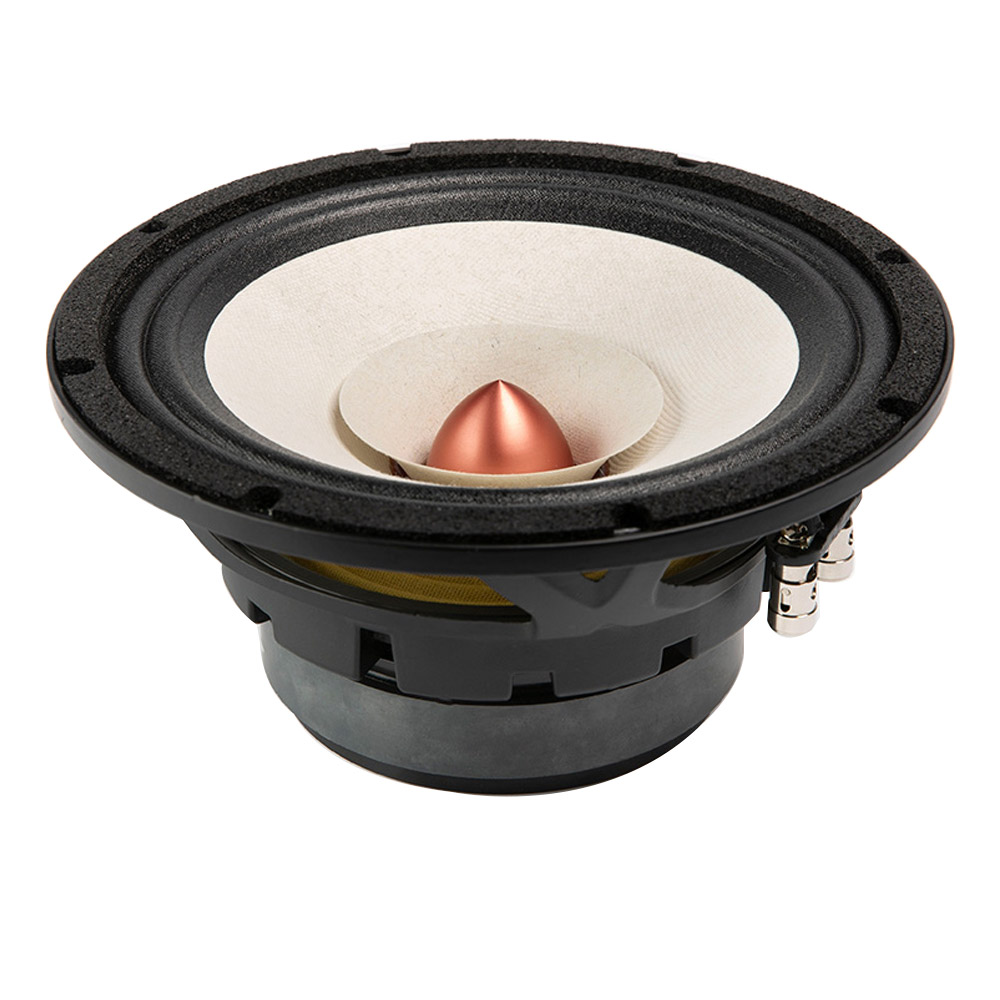
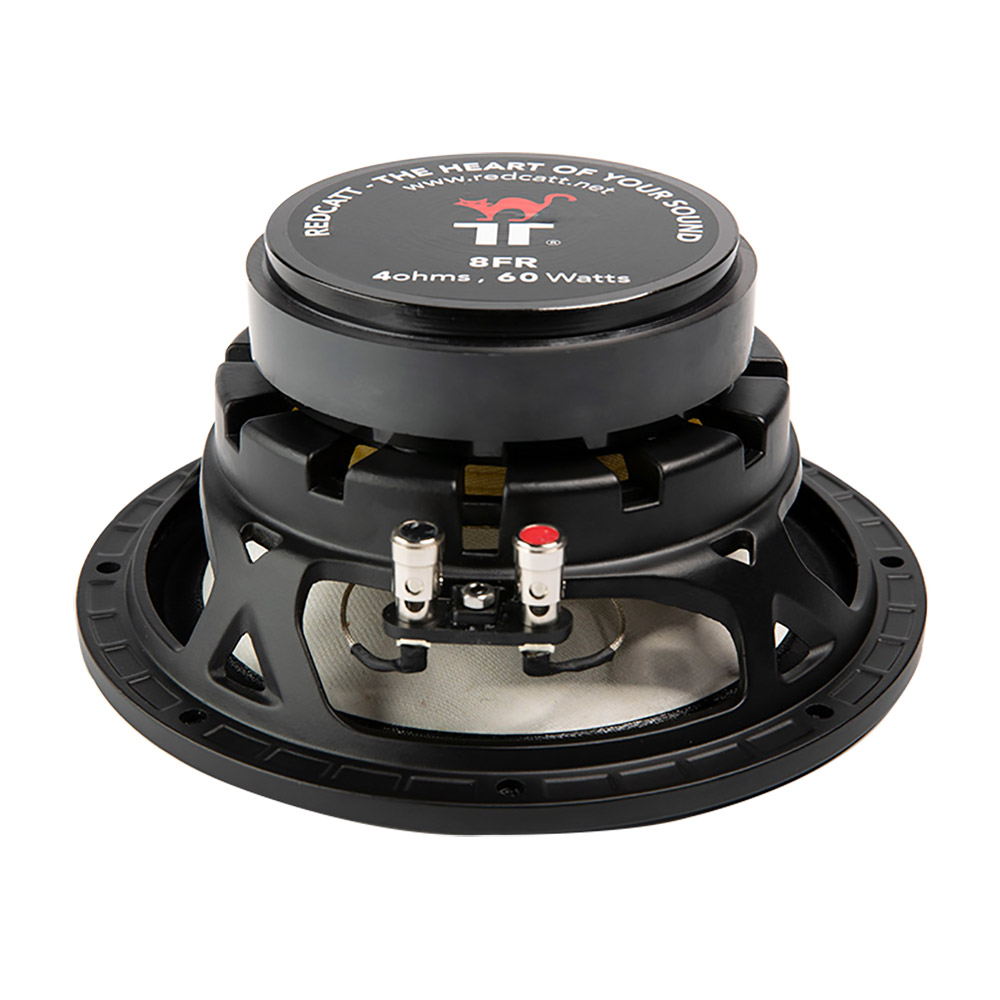
- lighweight, yet strong paper cone reinforced by bamboo fibers
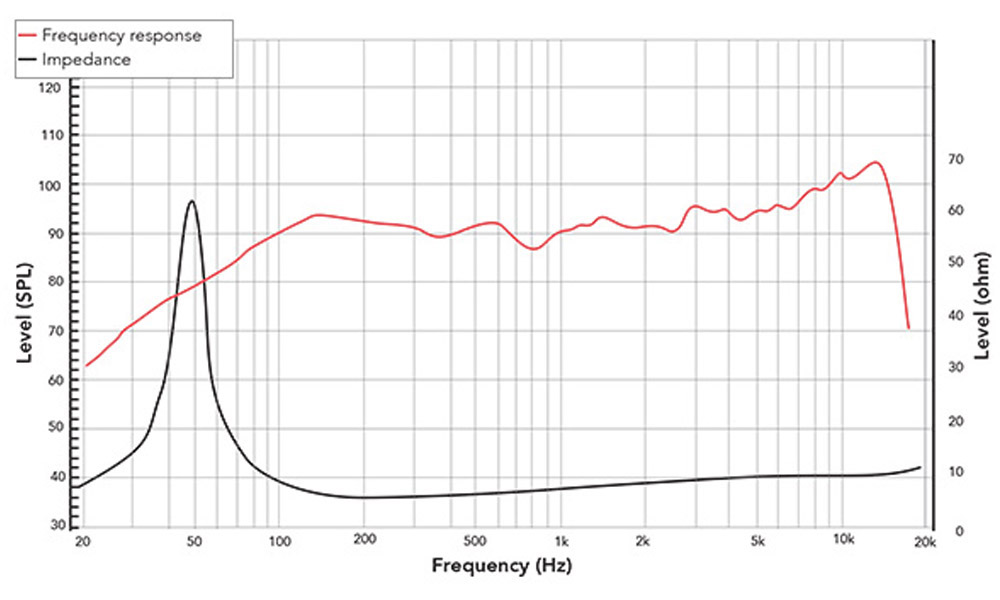
- working range up to 15kHz
- aesthetics tuned for moder hi-fi look
- 8FR was developed for Hi-Fi applications where single point audio source is required. Our engineers designed the cone to be lightweight, yet strong, using our new paper pulp reinforced by bamboo fibers. The driver sports wizard cone that extends the working range up to 15kHz, paired with bullet style phase plug. Combination of these
- two key features ensures smooth frequency response and an optimal sound reproduction on and off axes. Magnetic circuit was design to deliver robust B field across the whole range of working frequencies. Additional copper shorting cup further improves the driver behavior in mid-high working region.
- The aesthetics of this driver were tuned to support modern hi-fi system designs, where the driver can be exposed to the end user. Distinctive colors ensures the driver can be featured as part of the overall industrial design.
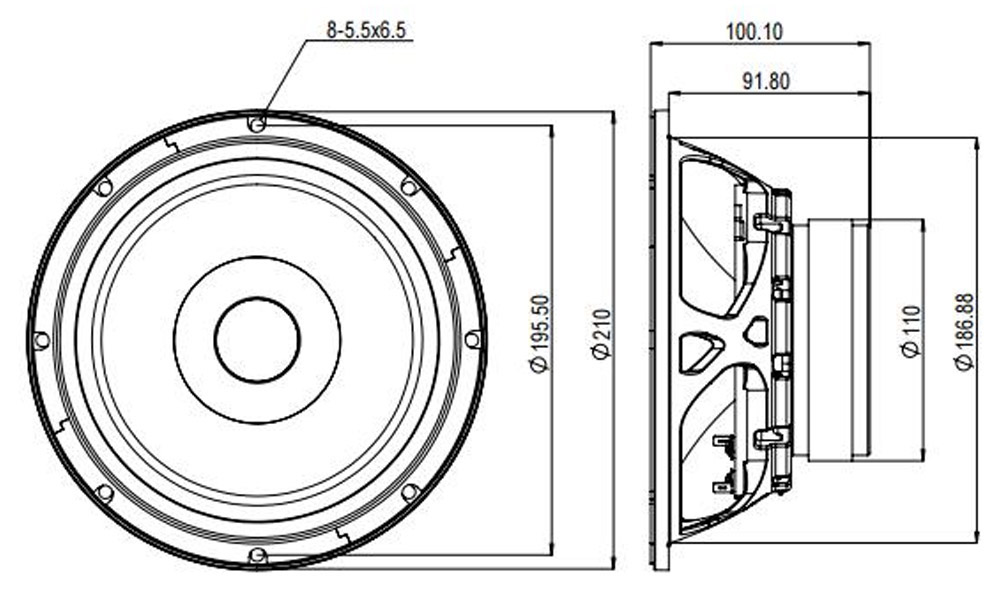
General specs Nominal Diameter: 8 in. Rated Impedance: 4 Ohm Power handling AES Power: 30 Watts Program Power: 60 Watts Voice Coil Diameter: 1.6 in. Winding wire: Aluminum Former: kapton Winding height: 17.6 mm T/S Parameters Resonant frequency: 53 Hz Re: 3.8 ohm Qes: 0.4 Qms: 8.47 Qts: 0.38 Vas: 36.8 liters Sd: 213.8 cm2 Mms: 18.38 grams Bl: 7.86 Le: 0.08 mH Sensitivity: 93 dB Design details Surround Material: Fabric Cone material: Paper Spider: Nomex Plate thickness: 6 mm Peak to peak linear cone Displacement 9.8 mm Overall diameter: 210 mm Bolt circle diameter: 195.5 mm Baffle cutout dia.: 186.88 mm Number of mounting holes: 8 Depth (flange to rear): 91.8 mm Net weight: 2.55 kg Ordering codes: 4 ohm version: 8FR-X4 ohm-551A Recone kits: Download: Spec download 2D drawing 3D model
'======================================================================
PRODUCT CODE: 8FRX4-551A
======================================================================
--- ENCLOSURE RECOMMENDATIONS ---
======================================================================
ENCLOSURE RECOMMENDATIONS: 8FRX4-551A
======================================================================A207
Driver: 8FRX4-551A (8FR) — 8" Full-Range (Hi-Fi / Open Baffle)
Key T/S: Fs=53Hz, Qts=0.378, Vas=36.8L, Sens=93dB 1W/1m
Power: AES 30W / Cont 60W / Peak 120W
Xmax=5.8mm (one-way linear), Xmech=11.8mm (protection at 9.8mm)
Sd=213.8cm², Bl=7.86T·m, Re=3.8Ω (4-ohm nominal), Mms=18.38g
Le=0.08mH (extremely low — wide-bandwidth motor design)
Voice Coil: 1.6" aluminum on Kapton former (17.6mm winding height)
Magnet: Ferrite with copper shorting cup | Basket: Aluminum
Cone: Bamboo fiber reinforced paper pulp with whizzer cone
Phase plug: Bullet style | Surround: Fabric
NOTE: This is a dedicated hi-fi full-range driver with a whizzer
(secondary) cone for extended high-frequency response to 15 kHz
and a bullet-style phase plug for controlled off-axis dispersion.
The extremely low voice coil inductance (0.08 mH) and copper
shorting cup ensure flat impedance and clean response through the
upper midrange and treble. Designed primarily for open baffle (OB)
applications, but also suitable for sealed and vented enclosures.
======================================================================
PRIMARY — Open Baffle (OB)
======================================================================
Open baffle mounting is the intended application for this driver.
In OB, the driver radiates as a dipole — front and rear waves are
in opposite polarity and partially cancel at low frequencies. Above
the baffle frequency (fb), the response is essentially flat. Below
fb, the response rolls off at approximately 6 dB/octave due to
dipole cancellation.
BAFFLE FREQUENCY vs BAFFLE WIDTH:
Baffle Width fb (Hz) Notes
──────────────────────────────────────────────────
40 cm 273 Small desktop/nearfield
50 cm 218 Compact stand-mount OB
60 cm 182 Medium floor-standing OB
80 cm 136 Large floor-standing OB
100 cm 109 Very large statement OB
Formula: fb = 343 / (π × baffle_width_in_meters)
RECOMMENDED OB CONFIGURATIONS:
a) OB — Compact (50 cm wide baffle)
Baffle Frequency: 218 Hz
Dipole rolloff below 218 Hz at ~6 dB/octave
Usable bass (no EQ): ~120–150 Hz
With DSP bass EQ (+6 dB/oct shelving): usable to ~60–70 Hz
EQ boost at Fs (53 Hz): ~12 dB
Baffle suggestion: 50 × 70 cm minimum, 18–25mm birch plywood
Notes: Compact OB for nearfield/desktop or small room use.
Requires significant DSP bass boost to achieve flat response
below 200 Hz. The small baffle allows excellent imaging and
disappearing soundstage. Best paired with a dipole subwoofer
(OB sub or H-frame) for full-range reproduction.
b) OB — Standard (60–70 cm wide baffle)
Baffle Frequency: 156–182 Hz
Dipole rolloff below 156–182 Hz at ~6 dB/octave
Usable bass (no EQ): ~100–120 Hz
With DSP bass EQ (+6 dB/oct shelving): usable to ~50–60 Hz
EQ boost at Fs (53 Hz): ~9–11 dB
Baffle suggestion: 60–70 × 90–100 cm, 18–25mm birch plywood
Notes: The recommended starting point for most OB builds.
Moderate DSP bass boost achieves a musically satisfying
full-range response. Good balance between bass extension,
imaging, and practical room placement. Can work as a
stand-alone full-range system in smaller rooms, or paired
with a subwoofer for larger spaces.
*** RECOMMENDED FOR MOST OB APPLICATIONS ***
c) OB — Large (80–100 cm wide baffle)
Baffle Frequency: 109–136 Hz
Dipole rolloff below 109–136 Hz at ~6 dB/octave
Usable bass (no EQ): ~80–100 Hz
With DSP bass EQ (+6 dB/oct shelving): usable to ~40–50 Hz
EQ boost at Fs (53 Hz): ~6–8 dB
Baffle suggestion: 80–100 × 120–140 cm, 18–25mm birch plywood
Notes: Large baffle provides the deepest bass without
requiring excessive EQ. Less DSP boost means less excursion
demand at low frequencies, improving dynamic headroom. The
large baffle provides more acoustic loading but begins to
narrow horizontal dispersion at higher frequencies. Best
for dedicated listening rooms where room placement allows
large panels.
OPEN BAFFLE DESIGN NOTES:
- Baffle should be made from acoustically inert material (birch
plywood, MDF, or bamboo laminate — 18mm minimum, 25mm preferred)
- Bracing behind the driver cutout is recommended to minimize
baffle vibration
- Driver offset from center (both horizontally and vertically)
reduces edge diffraction artifacts
- Room placement: OB speakers require distance from rear wall
(minimum 50–80 cm) to avoid comb filtering from rear wave
reflections
- The dipole radiation pattern provides a natural, spacious
soundstage with minimal room excitation compared to monopole
(boxed) speakers
- The whizzer cone handles frequencies above approximately
3–5 kHz; its integration with the main cone provides the
wide-bandwidth single-point-source characteristic
- DSP bass equalization: a 6 dB/octave shelving boost below the
baffle frequency restores flat response. Monitor excursion —
the driver's 5.8 mm Xmax limits maximum output at low
frequencies under heavy EQ boost
======================================================================
ALTERNATIVE — Sealed Enclosures
======================================================================
For listeners who prefer a traditional boxed speaker, sealed
enclosures provide smooth, predictable rolloff and are simpler to
build than OB. The Qts of 0.378 produces overdamped sealed
alignments in practical volumes — the gentle rolloff integrates
well with room gain in domestic environments.
d) SEALED — Compact (Qtc ≈ 0.7)
Net Volume: 15 liters
System Resonance (fc): 98 Hz
Qtc: 0.70
Response: Butterworth, maximally flat sealed response
Notes: Most compact practical sealed alignment. The fc of
98 Hz is relatively high — the speaker will roll off below
100 Hz and rely on room gain for usable response into the
70–80 Hz range. Best when paired with a subwoofer for bass
support, or for nearfield desktop use where proximity gain
assists low-frequency extension.
e) SEALED — Balanced (Qtc ≈ 0.6)
Net Volume: 25 liters
System Resonance (fc): 83 Hz
Qtc: 0.60
Response: Overdamped, smooth gentle rolloff
Notes: Good balance between cabinet size and bass extension.
The overdamped response provides a natural, warm rolloff
that sounds musical without excessive resonance. With room
gain, in-room response extends usably to ~55–60 Hz. A good
starting point for a full-range bookshelf or stand-mount
speaker without a subwoofer.
*** RECOMMENDED SEALED ALIGNMENT ***
f) SEALED — Extended (Qtc ≈ 0.5)
Net Volume: 50 liters
System Resonance (fc): 70 Hz
Qtc: 0.50
Response: Heavily overdamped, very gradual rolloff
Notes: Large enclosure providing the lowest sealed fc. The
heavily overdamped alignment rolls off very gradually,
providing usable response well below fc with room gain
(estimated in-room -3 dB around 45–50 Hz). Suitable for
a floor-standing full-range speaker in a medium to large
room. The large cabinet volume makes this a substantial
piece of furniture.
======================================================================
ALTERNATIVE — Bass Reflex (Vented) Enclosures
======================================================================
Vented enclosures provide deeper bass extension than sealed in the
same volume, but introduce port-related artifacts (chuffing, resonance
at tuning frequency). For a hi-fi full-range driver, sealed or OB is
generally preferred for purity of reproduction, but vented is an
option where maximum bass extension from a compact enclosure is
required.
g) VENTED — Compact
Net Volume: 27 liters
Tuning (Fb): 61 Hz
Est. -3dB: 56 Hz
HP Filter: 51 Hz (24dB/oct recommended)
Round Port: 65mm dia × 51mm long
Port Velocity: 14.3 m/s
Notes: Higher tuning for stronger upper-bass output and
compact cabinet. Good for a vented bookshelf-sized
full-range speaker.
h) VENTED — Balanced
Net Volume: 31 liters
Tuning (Fb): 55 Hz
Est. -3dB: 51 Hz
HP Filter: 45 Hz (24dB/oct recommended)
Round Port: 65mm dia × 58mm long
Port Velocity: 12.9 m/s
Notes: General-purpose alignment with good extension
relative to cabinet size. Usable bass response to ~50 Hz
with room gain extending further.
i) VENTED — Extended
Net Volume: 37 liters
Tuning (Fb): 48 Hz
Est. -3dB: 41 Hz
HP Filter: 38 Hz (24dB/oct recommended)
Round Port: 65mm dia × 68mm long
Port Velocity: 11.3 m/s
Notes: Maximum bass extension, reaching into the low
40s Hz anechoic. A compelling option for a vented
floor-standing full-range speaker. Port velocities are
moderate and well-controlled.
VENTED NOTE: Port lengths are short (51–68 mm) and velocities are
moderate (11–14 m/s), making port design straightforward. A simple
rear-mounted 65 mm round port is sufficient. Consider a flared port
for lowest noise in critical listening applications.
--- SUMMARY ---
The 8FRX4-551A is an 8-inch full-range driver designed for hi-fi applications where a single-point audio source is required, including open baffle, sealed, and vented loudspeaker systems. It features a lightweight bamboo fiber reinforced paper cone with an integrated whizzer (secondary) cone for extended high-frequency response to 15 kHz, a bullet-style phase plug for controlled off-axis dispersion, and a 1.6-inch aluminum voice coil on a Kapton former. The ferrite motor circuit with copper shorting cup and extremely low voice coil inductance (0.08 mH) provide flat impedance behavior and clean, wide-bandwidth reproduction from a single driver. At 93 dB sensitivity (1W/1m) with a moving mass of only 18.4 grams, the driver is efficient and fast, with good transient response across its full operating range.
The driver is primarily intended for open baffle (OB) mounting, where it radiates as a dipole source. On a standard 60–70 cm wide baffle, the dipole response is flat above approximately 155–180 Hz, with a 6 dB/octave rolloff below this frequency due to front-to-rear cancellation. DSP bass equalization (a shelving boost of approximately 6 dB/octave below the baffle frequency) restores flat response and extends usable bass to 50–60 Hz depending on baffle dimensions and EQ headroom. Larger baffles (80–100 cm) reduce the required EQ boost and provide deeper unaided bass extension. The dipole radiation pattern inherent to OB mounting provides a natural, spacious soundstage with minimal room excitation compared to conventional boxed loudspeakers.
For enclosed alternatives, sealed enclosures of 15 to 50 liters produce system resonances between 70 and 98 Hz with Qtc values of 0.5 to 0.7. A 25-liter sealed enclosure (Qtc 0.6, fc 83 Hz) is the recommended starting point, providing a smooth overdamped rolloff that integrates naturally with domestic room gain for in-room bass extension to approximately 55–60 Hz. Vented enclosures of 27 to 37 liters tuned between 48 and 61 Hz extend the anechoic -3 dB point to approximately 41–56 Hz with moderate port velocities (11–14 m/s). In all configurations, the driver is rated for 30 W AES / 60 W continuous power handling, which is appropriate for domestic listening levels given the 93 dB sensitivity.
This driver is particularly effective in hi-fi open baffle loudspeakers, single-driver sealed or vented cabinets, and full-range desktop monitors where point-source imaging, wide-bandwidth reproduction from a single driver, and natural tonal character are priorities. The bamboo fiber cone, whizzer cone extension to 15 kHz, and aesthetically refined design (exposed aluminum basket, distinctive colorway) support both high sound quality and modern industrial design integration.
──────────────────────────────────────────────────────────────────────



Back Top


